AI Customer Service: All You Need To Know
Learn how AI agents in customer service actually work, how they can help your business, and how to get it right.




Key Takeaways
- The best AI use cases are tied to measurable business workflows like qualification, support, booking, and personalization.
- Strong AI voice deployments need clean data, clear handoff rules, reliable integrations, and low-latency conversation handling.
- Use this guide to connect AI automation ideas to practical customer operations.
Businesses struggle to scale customer service. Demand grows. Customer expectations grow. Channels multiply. But hiring, training, and maintaining large support teams doesn’t scale at the same rate.
And even when companies do scale support operations, maintaining service quality becomes another challenge.
Why? Because customers don’t just want quick answers. They expect responses that feel empathetic, clear, and human.
AI in customer service emerged as a solution to that imbalance.
And it is not just about answering questions faster. AI can also proactively update customers about things that matter, like delivery timelines, order changes, or loan statuses. It reduces the number of support requests in the first place.
The problem? Most discussions stop at “chatbots” and never explain the operational mechanics behind it.
So let’s break it down properly.
BOOK A DEMO
Ready to deploy production-grade voice AI?
See how Ringg AI helps teams launch reliable voice agents across support, sales, operations, and industry workflows.
What’s AI in Customer Service?
AI in customer service is using machine intelligence to handle and improve how a business communicates with its customers. That includes before, during, or after a sale.
Now, a lot of people hear that and immediately picture a chatbot with canned responses and zero personality. But that's just one small piece of a much larger picture.
AI in customer service today covers everything from voice agents that hold actual phone conversations to tools that give the right answer to your human rep mid-call.
In fact, there are systems that predict which customer is about to churn before they even raise a complaint.
It's a wide umbrella, and the businesses treating it as "just a chatbot plugin" are the ones leaving the most value on the table.
Here’s why this matters right now:
- Smart AI can have a high deflection and resolution rate. That means your AI agents will be resolving 50%-60% customer routine inquiries without any involvement from a human agent.
- Average wait times can drop from several minutes to under 3 seconds after AI deployment. That's a different experience entirely.
- And for businesses still scaling support through headcount alone, operational costs can run up to almost 3X higher compared to teams using AI automation.
The shift is already happening. The question is just where you are in it.
Read Also - Conversational AI For Customer Support
Benefits of Using AI in Customer Service
The old way of scaling support was expensive, inconsistent, and exhausting. Artificial Intelligence changes that math entirely. Here are the actual benefits of AI:
- You scale support without also inflating costs
- Every customer gets the same consistent support (regardless of the hour)
- 24/7 availability
- Faster resolution
- Your agents stop being answer machines and start being problem solvers
To better show the impact generative AI can bring to customer satisfaction, I’ll share an example.
Practo (India's largest healthcare platform that connects patients to doctors across 2,500+ hospitals) had a volume problem.
Appointment booking calls were flooding in daily. And handling them manually meant more agents, more training, and more inconsistency. Plus, the costs would scale linearly with every new request. Not sustainable.
So, Practo deployed Ringg AI's voice agents across their hospital network to handle inbound booking calls. The agent would check doctor availability, match specialties, and confirm slots with natural language processing.
The results came within months:
- 30,000+ appointments handled by AI monthly, with 85% first-call resolution
- Wait times dropped to under 3 seconds
- Operational costs reduced by an estimated 70% compared to traditional call center expansion
- 24/7 availability across late-night bookings, weekend changes, and peak season spikes without any additional staffing
And here's the part worth paying attention to: their human staff didn't disappear. They got redeployed to complex medical queries, anxious patients, and edge cases that genuinely need a person.
The AI took the volume. The humans took the nuance.
That's the actual benefit of AI in customer service when it's done right.
Types of AI Used in Customer Service
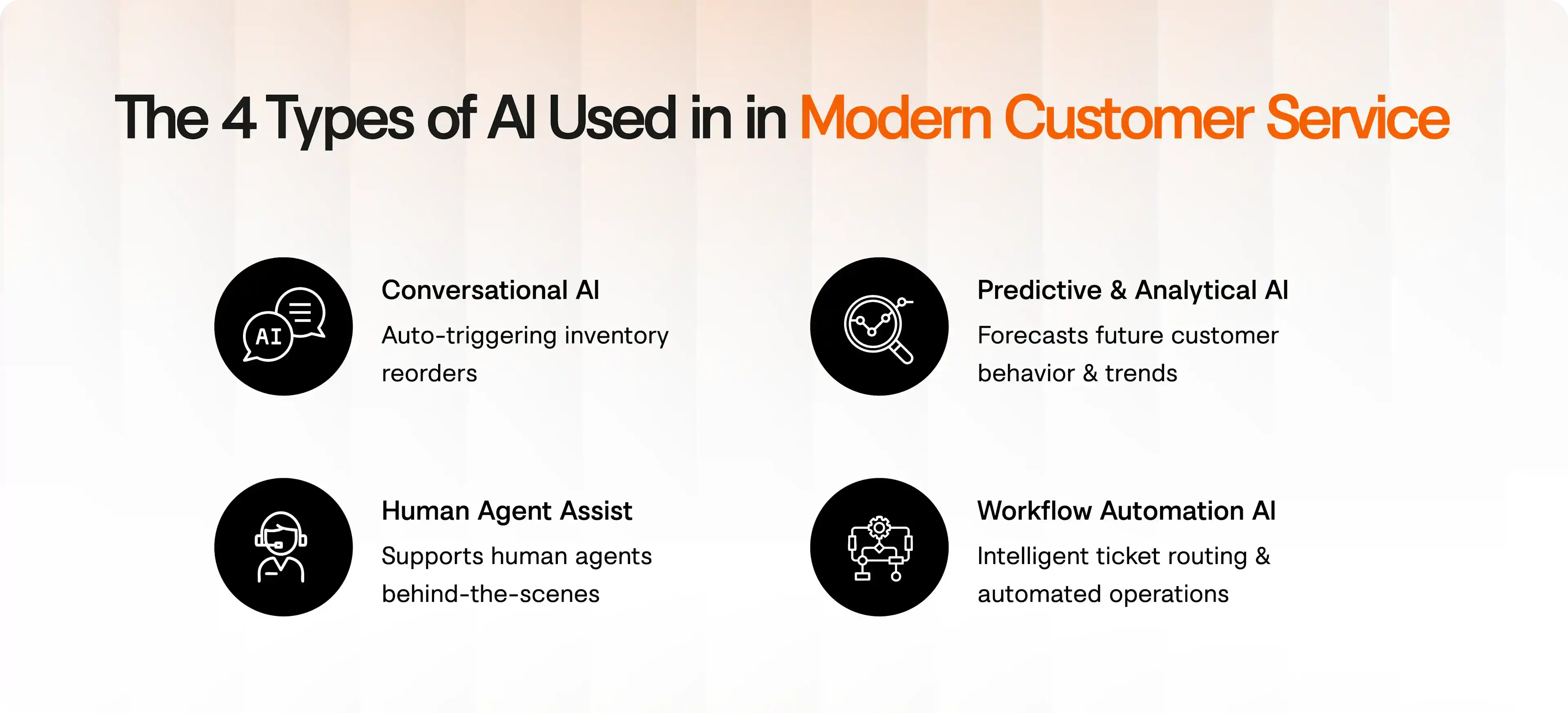
Like we said earlier, AI in customer service is not one thing. And if you're going to build anything serious with it, you need to know what's what. So here's a quick map.
Conversational AI (Chat & Voice)
This is the most visible category. The ones your customers actually interact with directly.
On the chat side, you've got AI chatbots. It handles FAQs, basic troubleshooting, order updates, and anything transactional over text.
It’s fast, always-on, and cheap to run at scale.
On the voice side, you've got AI voice agents. These are the systems that handle actual phone conversations in natural language.
FYI: These are not those robotic press-1-for-billing IVR of the past. We are talking about actual back-and-forth conversations that understand context and resolve customer inquiries.
Platforms like Ringg AI operate here. You can build specifically for high-volume voice interactions across industries like healthcare, finance, and logistics.
AI Assistants for Human Agents
This one works behind the scenes. Your customer never sees it, but your support agents feel it.
Here’s what it does while your rep is on a live call or chat:
- AI pulls up relevant account history
- Suggesting the next best response
- Flags if the customer's sentiment is turning negative
- Summarizes the entire interaction the moment it ends.
This way, your support team no longer needs to scramble around for context. No more post-call admin eating up half the day.
Also, advanced conversational AI technologies are emotionally intelligent and hand over edge cases to human agents. And it also fulfils the role of an AI assistant for human agents because it provides them with the context of the call, so the customers don't have to repeat themselves.
Predictive & Analytical AI
Ok… this is one of those advanced key features, but it’s where AI stops being reactive and starts being genuinely useful at a strategic level.
How? By helping you predict churn. It can flag if customers are likely to leave before they actually do.
It also helps with intent modeling. It’s where you understand what a customer actually wants. But the real value comes from what you do with those valuable insights.
If the system flags a customer as high churn risk, the business can trigger proactive outreach before the customer walks away.
Intent modeling also helps route conversations more intelligently. Instead of forcing customers through multiple menus or transfers, the system can immediately connect them to the right workflow, team, or resolution path.
Workflow & Process Automation AI
Now this is the operational backbone. It is where AI handles the stuff that nobody wants to do manually, but everyone needs done right.
This includes the following processes:
- Ticket routing: Reading the intent of an incoming query and sending it to the right team automatically.
- Auto-escalation: Detecting when something is spiraling and pulling in a senior agent before the customer has to ask.
- CRM syncing: Making sure every interaction updates the right record in real time, without anyone copy-pasting anything.
Read Also - AI Agents for Support
8 Most Impactful Ways to Use AI in Customer Service
Alright, this is where it gets practical. Here are the actual use cases driving business results right now.
1. Automated Inbound Query Resolution
Most support teams spend the bulk of their day answering the same questions. Order status. Password reset. Refund policy. Account balance. It's not complex work, it's just volume.
AI can handle up to 50%-70% of routine customer interactions, which means your human agents stop being answer machines and start being problem solvers.
The 35% that actually needs a person gets their full attention instead of a tired rep on their 20th call of the day.
The easiest way to implement this is to use AI agents and platforms that are programmed to intelligently detect and hand over complex issues to human support.
2. Outbound Voice Automation at Scale
Think about every outbound call your team makes manually. Payment reminders. Appointment confirmations. Delivery updates. Loan status follow-ups. Now think about doing all of that without a single human dialing a number.
Human agents can make 50-80 calls per day. AI voice agents can run thousands simultaneously. That too with consistent tone, zero fatigue, and smart retry logic for numbers that don't pick up.
For industries like BFSI, healthcare, and logistics, where outbound volume is relentless. This is the single highest-impact AI use case available right now.
3. Intelligent Ticket Routing & Prioritization
Ticket routing is the process of taking an incoming support request and sending it to the right team or agent.
But in practice, most companies do this manually or with basic rules. And it creates a mess.
But AI reads the intent, urgency, and context of every incoming query in real time and routes it accordingly.
High-value customer with a billing complaint? Senior agent, flagged as priority. Routine FAQs? Auto-resolved without touching a human queue.
This process leads to faster resolution and far fewer misrouted tickets, which eat up your team's time.
4. Real-Time Assistance for Human Agents
Your reps are on a live call. The customer is frustrated.
They're trying to remember the refund policy, find the account history, and keep the conversation from going sideways (all at the same time).
Agent assist AI fixes that. It listens to the conversation in real time and surfaces relevant information, suggests the next best response, and flags the moment customer sentiment starts turning negative.
The agent stays in control of the conversation. The AI just makes sure they're never flying blind.
5. Lead Qualification via AI Calls
We know that lead qualification is the process of figuring out whether a prospect is actually worth your sales team's time before handing them over.
Traditionally, a rep does this manually.
Call after call, the same screening questions, with varying consistency depending on the rep's energy level that day.
AI voice agents handle this at volume. They can ask the right questions, adapt based on responses, score the lead, and route only the warm ones to your sales team.
Implementing this won’t take more than 1-2 weeks (a couple days at max with Ringg AI), but the results are worth it.
6. Proactive Customer Support
The best customer service doesn't wait for a problem; it gets ahead of it.
AI enables businesses to proactively reach out to customers with updates they care about before they even think to ask.
When customers get this information proactively, two things happen: they feel taken care of, and your inbound query volume drops.
Because nobody needs to call and ask, “Where is my order?" if the answer has already reached them.
7. Post-Interaction Feedback Collection
Survey emails have a brutal open rate. People close them without a second thought.
An AI voice or chat agent that reaches out immediately after a support interaction gets a very different response.
The conversation feels natural, the customer feedback is richer, and you get a continuous real-time pulse on customer experience instead of a quarterly NPS report that's already two months stale by the time anyone reads it.
8. Conversation Analytics & Voice of Customer (VoC) Intelligence
So… conversation analytics means using AI to analyze your customer interactions at scale and surface patterns your team would never find manually.
VoC (Voice of Customer) is the insight you extract from this: what customers are actually saying, feeling, and struggling with.
Most businesses are sitting on a goldmine here and doing nothing with it.
PS. If you want to cover these use cases, Ringg AI is an AI voice agent platform that can help you handle most of them. It’s like an all-in-one platform for AI in customer service.
Read Also - Best AI Call Answering Services
What Mistakes are Businesses Making While Adopting AI for Customer Service
Here's the uncomfortable truth. Many businesses fail to adopt AI properly in customer service. And that's not an AI problem. That's an implementation problem. And the same mistakes keep showing up. Here are some of the most common ones.
1. Treating AI like a chatbot plugin instead of infrastructure
Most businesses deploy a chatbot, stick it on their website, and call it their "AI strategy." That's not a strategy. That's a widget.
AI in customer service works when it's woven into your operations. This includes connecting with your CRM, your ticketing system, your voice stack, and your predictive analytics layer. When it's treated as a plugin, it behaves like one: surface-level, siloed, and easy to ignore.
2. Over-automating emotionally sensitive interactions
Certain customer interactions should never be fully automated.
A customer is calling about a declined loan. A patient is following up on a difficult diagnosis. Someone is disputing a charge after a fraud incident.
These moments need a human touch. Sending an AI into them doesn't just fail to help; it actively damages trust.
3. Not training humans to work alongside AI
AI doesn't replace your team. It changes how your team works. And if you roll it out without bringing them along, you've already lost.
When management isn't ready to adopt an AI tool, failure is a byproduct. Sales teams don't trust the AI lead scoring.
Customer service reps prefer their own judgment over AI suggestions. Analysts treat it like a black box. Adoption collapses quietly, and nobody can explain why the numbers aren't moving.
4. Ignoring latency (especially for voice AI)
This one kills voice deployments silently. A half-second delay in a chat feels fine. A half-second pause mid-sentence on a phone call?
It sounds broken. Customers lose trust in the interaction instantly, and many just hang up.
If you're evaluating voice AI platforms and latency isn't one of the first things you're testing, you're setting yourself up for a deployment that looks great in a demo and frustrates real users in production.
5. Not training the AI well enough
Undertrained AI speaks with authority it hasn't earned.
It can confidently give wrong answers, make promises your team can't keep, and erode customer trust at the exact moment you need to build it.
The AI is only as good as what you put into it. So make sure you train it properly and give strict instructions to not hallucinate.
6. Not integrating with CRM and ERP
Customers have been treated poorly due to cost-cutting, outsourcing, and the lack of CRM integration. AI without context is just noise.
If your voice agent can't see the customer's history, your chatbot can't pull up their order, and your analytics layer isn't feeding back into your systems. You haven't built a smarter operation; you've just added another disconnected tool to the stack.
7. Focusing only on cost savings instead of CX impact
The businesses deploying AI purely to cut headcount are the ones generating those failure stats.
Nearly one in five consumers who've used AI for customer service saw zero benefit. It’s a failure rate almost four times higher than for AI use in general.
Cost efficiency is a byproduct of good AI implementation. When you chase it as the primary goal, you cut corners on the experience.
8. Not measuring the resolution rate properly
Deflection rate and resolution rate are not the same thing. A lot of teams celebrate high deflection without checking whether those customer queries were actually resolved.
Speed without substance is just expensive frustration.
If your AI is closing tickets without solving problems, your CSAT will eventually tell you. So… it is better to measure it properly from day one.
The Modern Tech Stack for AI in Customer Service
Before we get into tools. One thing worth saying upfront: Don't buy a platform. Buy for your use case.
The biggest stack mistakes happen when businesses pick the most popular tool, or the one with the best sales deck, without asking, "Does this actually solve the specific problem we have?"
Figure out where your biggest gap is. Then find the tool that closes it.
Here's how the landscape looks right now, broken down by category:
Voice AI & Outbound Automation
These AI systems handle phone calls for inbound support, outbound reminders, lead qualification, and follow-ups (at scale).
This is the most underinvested category in most customer service stacks, and also the highest-impact one for industries where the phone is still the primary channel.
| TOOLS | BEST FOR |
|---|---|
| ----------- | -------------- |
| Ringg AI | Enterprise outbound automation across healthcare, BFSI, logistics, and EdTech. <400 ms latency, 20+ languages, no-code builder. Built specifically for high-volume voice operations. |
| Retell AI | Developer teams that need a clean, low-latency voice API with solid customization options. |
| Bland AI | High-volume outbound campaigns on a budget. Simple API, decent throughput, limited analytics. |
AI Chatbots & Messaging Automation
These tools interact with customers through text channels like website chat, WhatsApp, in-app messaging, and email. The most mature and crowded category.
| TOOLS | BEST FOR |
|---|---|
| ----------- | -------------- |
| Intercom Fin | SaaS and tech companies that want deep product integration and smooth AI-to-human handoff. |
| Tidio Lyro | Small and mid-sized businesses want fast setup, solid automation, and multichannel support without a heavy tech lift. |
| Gorgias | E-commerce brands (like Shopify) need order tracking, returns, and refund automation baked in. |
CRM & Data Layer
The platforms store customer data and interaction history.
Without this layer talking properly to your AI tools, every interaction starts from zero, and that’s where experience breaks down. Also, you need to make sure that they follow data privacy norms.
| TOOLS | BEST FOR |
|---|---|
| ----------- | -------------- |
| Salesforce | Enterprise teams that need deep AI integration, a massive ecosystem, and Einstein AI built in. |
| HubSpot | SMB to mid-market teams wanting an easy-to-use CRM with solid native AI features. |
| LeadSquared | Sales-heavy operations, particularly in BFSI and EdTech, in the Indian market. |
Real-Time Human Agent Assist
These are the tools that work behind the scenes during live conversations. It surfaces context, suggests responses, does sentiment analysis, and summarizes calls the moment they end.
| TOOLS | BEST FOR |
|---|---|
| ----------- | -------------- |
| Salesforce Einstein | Teams already in the Salesforce ecosystem want in-call guidance and automated summaries. |
| Assembled Assist | Support teams that want AI helping agents without replacing them. Strong on omnichannel and human-centric design. |
| IBM Watson Assistant | Enterprise teams need high accuracy, complex multi-turn conversations, and strong compliance. |
Analytics & QA
These tools help you analyze customer conversations at scale.
| TOOLS | BEST FOR |
|---|---|
| ----------- | -------------- |
| Observe.AI | Contact centers focused on agent coaching, QA automation, and compliance monitoring. |
| Gong | B2B sales and support teams want deep conversation intelligence and revenue insights. |
| Zendesk QA | Teams already on Zendesk want automated conversation scoring without adding another platform. |
Note: If you're wondering whether one platform can cover most of these categories, Ringg AI comes pretty close. You get voice AI, outbound automation, analytics, and deep CRM integration, all under one roof.
BOOK A DEMO
Ready to deploy production-grade voice AI?
See how Ringg AI helps teams launch reliable voice agents across support, sales, operations, and industry workflows.
Conclusion
Here's the thing nobody tells you about AI in customer service.
The businesses winning with it aren't the ones with the most tools. They're the ones who are clearest about where AI helps and where a human still needs to show up.
Because at the end of the day, your customers don't care whether it was AI or a human that helped them.
They care that someone was there, got it right, and made them feel like they mattered.
AI gives you the ability to deliver that at any hour, in any language, at any volume.
Frequently Asked Questions
Not quite. In fact, the businesses treating it that way are the ones running into trouble. AI is replacing the tasks that were never the best use of a human's time in the first place. What's left for human agents is actually more meaningful work that needs judgment.
Related blogs
View all blogs
AI Use Cases
Where AI Agents Actually Work in D2C and E-Commerce: 6 High-ROI Use Cases from Production
A breakdown of 6 proven use cases where AI agents drive outsized returns for D2C and e-commerce brands - from context-rich abandoned cart recovery to automated campaign generation. Based on real enterprise deployments, not demos
06 Jul 2026 · 8 min read
AI Use Cases
How To Use AI Agents For Lead Qualification: A Complete Guide
Use AI voice agents to qualify leads faster, route high-intent prospects, and help sales teams focus on closing.
07 Jul 2026 · 15 min read
AI Use Cases
6 AI Agent Use Cases in E-Commerce That Actually Pay Off
Real production use cases where AI agents generate measurable ROI for D2C and e-commerce brands, from cart recovery to COD verification.
06 Jul 2026 · 10 min read