A Complete Guide on Conversational AI For Customer Support
Stop making callers wait. Discover how modern voice automation transforms telephone support and scales operations instantly.





Customer service automation meant frustrating phone menus and robotic chatbots trapping users in endless communication loops for decades. In 2026, that has changed. Conversational AI for customer support now resolves problems with human-level intelligence rather than deflecting them to a queue.
According to Gartner, by 2029, agentic AI will autonomously resolve 80% of common customer service issues without human intervention. The shift spans FinTech, healthcare, logistics, and e-commerce, with measurable reductions in cost per contact already visible across live enterprise deployments.
Modern enterprises are moving past text scripts to deploy AI voice agent solutions that listen and act in real time. Whether handling a refund or scheduling a field technician, these systems are redefining the baseline for customer experience.
In this guide, we explore how this technology works, the growth of voice AI for customer support industry, and why operations leaders are choosing Ringg AI to power their next-generation customer support.

What Is Conversational AI For Customer Support?
Conversational AI for customer support enables automated systems to handle service interactions through natural two-way dialogue. These systems detect caller intent, retrieve live data, and resolve queries autonomously across voice, chat, SMS, and email channels without scripted menus or constant human intervention at every step.
Three core technical layers determine how well any conversational AI for customer support platform performs in live enterprise conditions.
- Natural Language Understanding: The AI voice agent in customer support deciphers complex customer intents regardless of local slang and regional accents. It understands what the caller actually means, providing accurate customer service without requiring any human intervention.
- Generative Response: Modern automated systems generate dynamic conversational responses on the fly to create fluid and personal customer interactions. They outperform rigid legacy bots relying on strictly prewritten automated script pathways to answer basic questions.
- Omnichannel Execution: True conversational technology persists the exact interaction context across various communication channels to benefit your daily service operations. This unique capability allows seamless transitions from website text chat to an AI voice assistant for customer support.
Types of Conversational AI
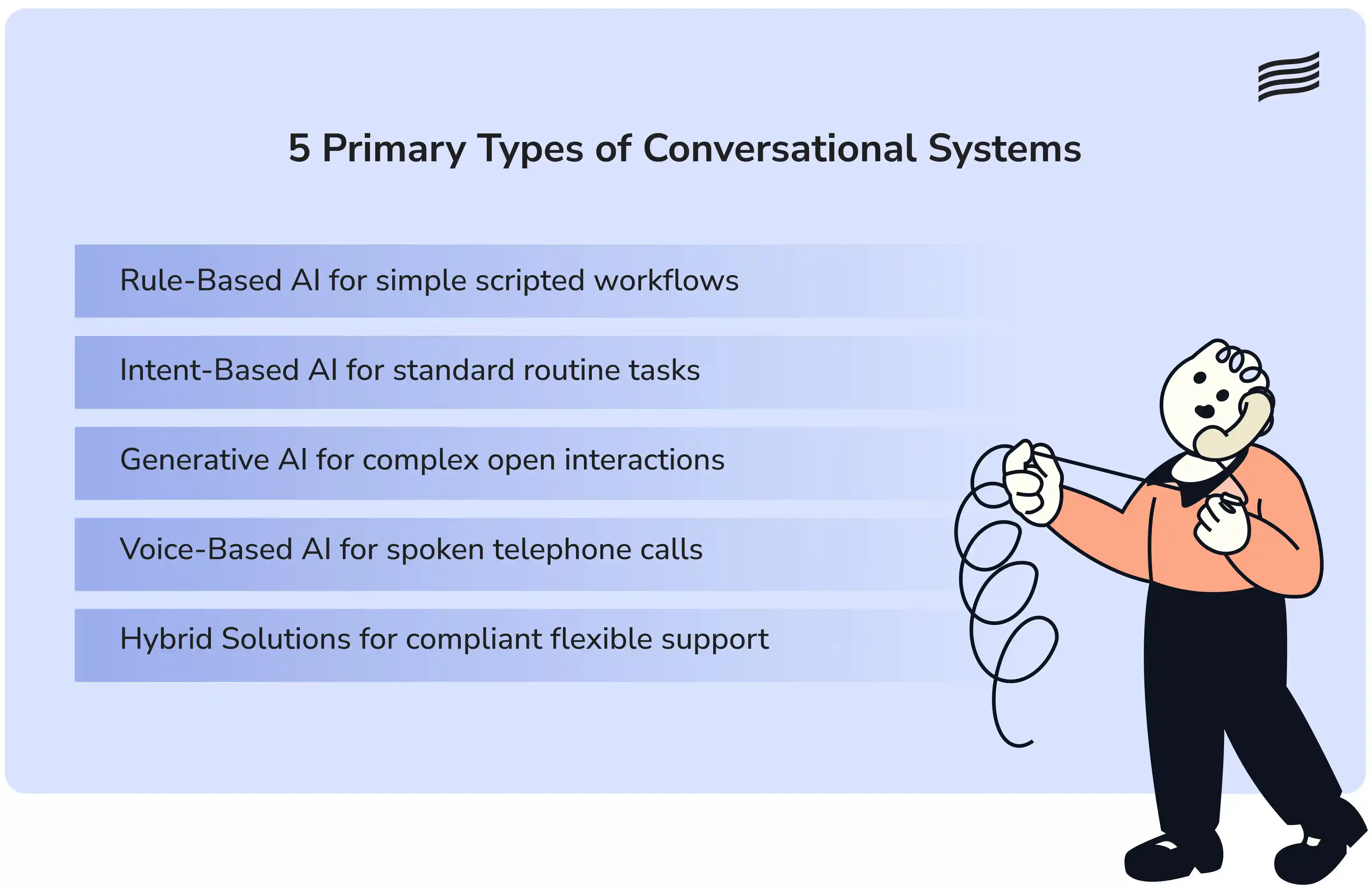
Not all conversational AI architectures share the same underlying approach. The model behind each type determines its accuracy and how quickly operations teams can iterate on deployed agents.
- Rule-Based AI: Follows predefined scripts and decision trees using keyword triggers. Reliable for simple, predictable queries where customer phrasing stays consistent and compliance control over every response is a firm requirement.
- Intent-Based AI: Uses machine learning to recognize user intent across varied phrasing and conversation context. Handles routine service tasks with reasonable accuracy and requires less upfront scripting than rule-based approaches to get live.
- Generative AI-Based: Leverages large language models to produce dynamic, context-aware responses for open-ended or multi-step customer queries. Performance scales directly with model quality and the depth of knowledge base integration.
- Voice-Based AI: Converts spoken language into actionable text to enable fully verbal interactions in automated call environments. Ringg AI serves as an excellent operational example by processing voice at sub-400ms latency, making every interaction feel natural rather than mechanical to the caller.
- Hybrid Solutions: Combines fixed compliance rules with advanced AI reasoning for complex enterprise environments. Common in BFSI and healthcare deployments where regulatory control and conversational flexibility are both non-negotiable requirements simultaneously.
Why Is the Demand for Voice AI for Customer Support Growing?
Let’s have a look at the reasons behind the growing demand for conversational AI for customer support:
Challenges with Legacy Conversational AI Tools
The market is shifting because first-generation tools failed to deliver on their core promises, and the operational evidence has accumulated across BFSI, logistics, and retail sectors.
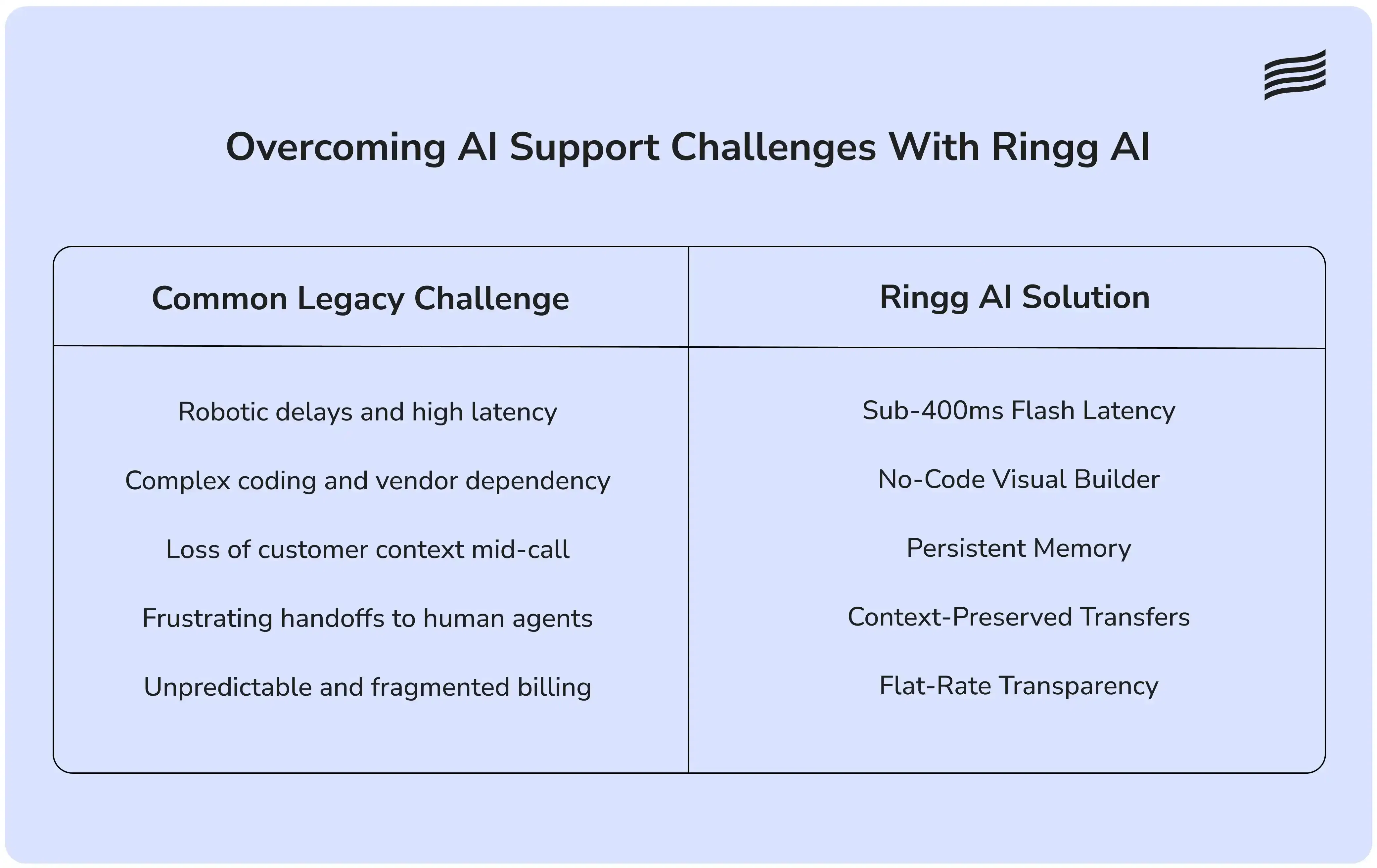
- High Latency and Delays: Multi-vendor architectures create two-second or longer delays between conversational turns. This latency breaks the natural dialogue rhythm and raises caller frustration on every call where each pause signals a broken system.
- Complex Implementation: Older platforms require months of vendor-managed configuration before any team can go live with a working agent. Operations leaders cannot update flows independently, creating a bottleneck every time a process or product offering changes.
- Lack of Control: Managed service providers operate as black boxes that prevent leaders from auditing specific call flows or verifying AI decisions. In regulated industries, this opacity creates direct compliance and accountability risk that procurement teams cannot accept.
Why Enterprises Are Adopting Modern Voice AI
Modern voice AI platforms are gaining adoption because they address the cost, scale, reliability, and quality requirements that legacy tools never resolved at the same time.
- Instant 24/7 Availability: Eliminates hold times across all time zones without staffing changes or overtime budget requirements.
- Cost Reduction: Automates 20 to 30% of inbound calls at a fraction of human agent cost, with direct measurable impact on cost-per-contact metrics.
- Scalability: Handles peak-season call spikes without proportional headcount growth or the lead time required for new infrastructure procurement cycles.
- Consistent Quality: Every caller receives a compliant, on-brand response regardless of call volume, time of day, or current agent availability across the team.
- Multilingual Support: Serves global customer bases in 20 or more languages from a single deployment, without the cost and lead time of hiring regional speaker teams for each market.
What Are Key Features of a Modern AI Voice Assistant?
Here are the key features that are the hallmarks of a capable conversational AI for customer support:
- Low-Latency Barge-In Handling: The system stops instantly when a customer interrupts mid-sentence. For instance, Ringg AI delivers this feature in sub-400ms, making AI voice for customer support feel like a two-way conversation rather than a script being played back to the caller.
- Contextual Memory: The agent recalls details shared earlier in the call and from previous interactions across sessions. Customers never repeat themselves, and first-call resolution rates improve as a direct result of this continuity.
- Sentiment Analysis: The platform monitors vocal tone to detect frustration or urgency in real time. When signals shift, the system adjusts its response style or routes the call to a human agent, preserving full context and attaching it.
- CRM Integration and the Action Layer: A capable voice agent acts within live systems rather than responding passively to queries. It pulls order status, updates account records, processes service requests, and confirms changes directly inside the CRM during the active call.
What Are Top Use Cases for AI Voice Agents?
Conversational AI for customer support delivers the fastest ROI when deployed on high-volume, repetitive call categories. Let’s have a look at the top use cases for AI voice agents:
- Inbound Call Triaging: The technology screens incoming telephone calls and routes customers to the correct corporate departments using spoken conversational prompts. It eliminates clunky numeric keypad menus and reduces the overall wait time for every inbound caller globally.
- Order Management and WISMO Queries: The system resolves ‘Where Is My Order’ questions by querying live shipping databases mid-call. Callers receive current information without waiting for a human agent to manually pull up the same data.
- Appointment Scheduling: The automated software negotiates available time slots and books client appointments directly onto your internal corporate company calendar. It sends digital calendar invites autonomously for service industry professionals to secure their daily business revenue streams.
- Secure Payment Processing: The secure platform handles routine bill payments and updates financial account balances safely over the live telephone connection. It manages sensitive credit card information without requiring any human intervention to maintain strict corporate data privacy standards.
- Proactive Outbound Alerts: The system automatically notifies your active customers regarding unexpected service outages and anticipated package delivery delays via telephone. This approach converts potential inbound complaint calls into proactive brand touchpoints at scale.
- Automated FAQ Resolution & Smart Escalation: The agent addresses common FAQs completely autonomously, significantly reducing the manual load on your human workforce. For unique or complex queries, it seamlessly transfers the call to the appropriate live representative with full conversational context. More generally, any repetitive workflow involving basic FAQs can be fully automated, drastically reducing human workload.
Which Industries Use Voice AI For Customer Support?
Voice AI technology is used across industries where call volume and service speed are crucial, directly affecting customer retention and operational costs.
Banking and Financial Services
- Account Inquiries and Fraud Alerts: Automated agents verify caller identity, surface account balances, and flag suspicious transactions in real time without routing to a live agent.
- Loan Servicing and Payment Processing: Callers check EMI schedules, make payments, and get loan status updates through a single voice interaction handled end to end.
Healthcare and Telemedicine
- Appointment Scheduling and Prescription Refills: Patients book, reschedule, and confirm appointments through natural voice dialogue. Ringg AI is HIPAA-compliant and directly deployable in regulated clinical environments.
- Insurance Verification and Patient Routing: Agents handle pre-authorization queries and direct patients to appropriate care pathways without adding load to front-desk or administrative teams.
E-Commerce and Retail
- Order Tracking and Return Processing: Agents resolve order status queries and initiate return requests using live data, completing resolution during the call without escalation to a human team.
- Product Recommendations and Purchase Guidance: Voice agents surface relevant product information and guide purchase decisions for callers in the pre-checkout or product research stage.
Telecommunications
- Plan Details and Service Troubleshooting: Agents explain current plan terms, surface available upgrades, and walk callers through basic troubleshooting steps without human agent involvement at any point.
- Bill Payments and Technical Support: Customers dispute charges, make payments, and log technical issues through voice interactions that complete the task before the call ends.
Travel and Hospitality
- Flight, Hotel, Car Rental, and Transfer Bookings: Agents complete end-to-end reservations through voice by accessing live availability data to confirm bookings in a single interaction.
- Changes, Upgrades, and Policy FAQs: Customers modify existing bookings, request upgrades, and get travel policy answers through a voice call that resolves the request without any human handoff.

How Does Ringg AI Transform Customer Support Automation?
Ringg AI represents the next evolution of conversational AI for customer support. Our platform has been built on a clear insight: enterprise voice AI fails when assembled from separate vendors for transcription, intelligence, voice synthesis, and telephony.
Ringg AI integrates all four layers into a single Voice Operating System, giving operations teams full control without the complexity that multi-vendor stacks create.
- Flash Latency: Ringg AI delivers sub-400ms audio response times to ensure your AI voice agent in customer support feels authentic and human. This optimized architectural speed creates a natural conversational flow that legacy systems cannot match under any circumstances whatsoever.
- Visual Workflow Builder: You do not need a dedicated team of software engineers to launch a functional and accurate automated customer support agent. Our intuitive visual builder allows managers to design complex logic flows and update communication scripts in several minutes.
- Deep Analytics: We provide full administrative visibility into every single call log and audio recording your intelligent automated agent makes daily. You have total administrative control to audit performance and improve your voice AI for customer support industry strategy instantly.
- Predictable Flat-Rate Pricing: A simple, all-inclusive per-minute rate covers telephony, AI intelligence, voice output, and analytics in a single transparent line item. There are no fragmented bills, hidden usage caps, or service retainers sitting outside Ringg AI pricing plans.
- Instant Scalability: Ringg AI handles thousands of concurrent calls during high-demand periods without infrastructure changes or advance provisioning. Our platform scales linearly with call volume from day one of deployment.
- Persistent Memory Across Sessions: The agent retains context across multiple calls and channels, ensuring customers never repeat previously shared details. This capability drives measurable improvement in first-call resolution rates across every industry vertical.
- Context-Preserved Human Handoffs: When a call exceeds the agent's defined scope, Ringg AI transfers with a full transcript and context attached. The customer continues the conversation from where they left off without restating the issue to a new agent.
Final Verdict: Choosing the Right Platform?
Adopting conversational AI for customer support is no longer a theoretical question for operations leaders. The efficiency gains and customer experience improvements are significant enough that the delay itself carries a measurable cost for any enterprise still running on legacy tools or fragmented vendor stacks.
Legacy platforms and black-box managed services slow iteration and create compliance risk in regulated environments. To compete in 2026, operations leaders need a platform that is agile, transparent, and built for production-grade voice speed. Ringg AI delivers the infrastructure and operational control required to deploy AI voice for customer support that actually resolves calls rather than routing them to a longer queue.
Start automating your customer support calls with Ringg AI. Book a free demo today.
Frequently Asked Questions
It is an advanced automated technology using artificial intelligence to resolve caller inquiries through natural spoken dialogue over the telephone. Conversational AI For Customer Support replaces static phone menus with dynamic and intelligent virtual assistants to solve problems instantly.
Related Articles
13 Best AI Calling Agents of 2026 Reviewed (So You Don’t Have To)
Compare the features, pricing, pros, and cons of the 13 best AI calling agents and select the right one for your use case.

How Businesses Use AI Call Automation to Scale Support
Learn how AI call automation transforms business communication with 24/7 availability, cost reduction & improved user satisfaction.
10 Best AI Voice Agent Platforms Rated and Reviewed
Compare India’s best AI voice agent platforms in 2026 to scale enterprise sales and customer service operations effortlessly.