Voice AI For Banking Customer Experience: Top 5 Use Cases
Discover proven voice AI use cases for banking like fraud alerts and servicing to boost efficiency.





In today's digital-first banking digital banking landscape, customer expectations for fast, personalized, and secure customer service continue to grow. Voice AI for banking companies has emerged as a powerful enabler of next-generation customer engagement, redefining how financial institutions interact with their customers. McKinsey Global Institute estimates AI could unlock between $200 billion and $340 billion in value annually for the global banking sector, with the largest gains coming from customer operations, and it's easy to see why. No longer limited to basic call routing or static menus, modern Voice AI systems powered by artificial intelligence, Generative AI, and Large Language Models (LLMs)- utilize natural language understanding, hold multi-turn conversations, and manage sensitive tasks securely at scale.
Let's explore five high-impact voice AI use cases for banking that every company in financial services, including large banks and credit unions, should implement to transform their operations and user experience.
The 5 Top Use Cases of Voice AI for Banking Customer Experience
1. Payment Collection and Reminders (Outbound)
Nothing damages customer relationships faster than poor communication about payments. Research shows that proactive, personalized reminders can significantly reduce delinquency rates while maintaining positive customer sentiment.
With voice AI for banking, banks can:
- Trigger automated, personalized voice calls for upcoming or overdue payments
- Authenticate customers securely before discussing sensitive customer data
- Offer multiple payment options (immediate payment, scheduling, payment plans)
- Process transactions in real-time or set convenient reminders
- Provide immediate confirmation and receipts
Banks using voice AI for banking companies to automate payment reminder calls have seen collection rates improve by up to 30% while reducing operational costs associated with manual follow-ups. The personalized nature of voice communication creates a stronger connection compared to emails or text messages, particularly for sensitive financial matters.

2. Account Fraud Alerts (Outbound)
In an era of increasing financial fraud, rapid response is critical. Voice AI enables banks to instantly alert customers about suspicious activities, potentially saving millions in fraud losses. Utilizing voice AI use cases for banking security ensures immediate action.
The fraud alert process includes:
- Urgent call introduction that clearly identifies the bank
- Secure authentication to verify the customer's identity
- Detailed alert about specific suspicious activity detected
- Transaction verification or rejection in real-time
- Immediate card blocking if needed
- Clear next steps for security measures
- Seamless human escalation for complex situations
HSBC UK's Voice ID system has successfully prevented nearly £249 million in attempted fraud by recognizing user voices and catching fake ones. Voice biometrics combined with behavioral pattern recognition creates a robust defense against unauthorized access and identity theft.
3. Personalized Financial Recommendations (Outbound)
Modern banking customers expect personalized service that anticipates their needs. Voice AI in banking customer experience can analyze customer financial patterns and deliver tailored recommendations that drive engagement and product adoption.
With personalized recommendation calls, banks can:
- Introduce relevant financial products based on spending patterns
- Authenticate customers before discussing account-specific insights
- Provide analysis of customer financial habits and opportunities
- Explain product benefits conversationally and answer questions
- Gauge interest through interactive dialogue
- Schedule appointments with human advisors for interested customers
- Maintain a relationship with appropriate follow-up
Banks across North America, Europe, and Asia-Pacific are rapidly adopting these tools, driven by user demand and regulatory needs. Voice agents like Garanti Bank's MIA are making it easier to access portfolio insights, market alerts, and investment suggestions without navigating complex apps or dashboards, bringing investment services closer to everyday users.
4. Account Servicing (Inbound)
Customers hate waiting on hold, and there are never enough customer support representatives to attend to customers. Using Voice AI transforms inbound account servicing by providing immediate, 24/7 assistance for common banking needs, serving as a pillar for voice AI in banking customer experience.
An effective account servicing voice bot handles:
- Welcoming customers with a friendly, brand-consistent greeting
- Secure authentication through voice biometrics or traditional methods
- Intuitive service menu navigation through natural conversation
- Processing routine requests instantly (balance checks, transaction history, transfers)
- Clear confirmation of all actions taken
- Proactive offers for additional assistance
- Professional closure that reinforces the banking relationship
Banks use AI voice agents to answer common questions, account balances, card limits, and recent transactions without keeping customers waiting. TD Bank saw over 20% drop in call wait times after launching their voice assistant, while tools like Posh AI automate 91% of incoming requests, helping cut abandonment rates by up to 93%. Gartner also reinforces why this matters at scale, showing how conversational AI in contact centers is projected to reduce agent labor costs by $80 billion by 2026, making inbound voice automation one of the highest-ROI investments a financial institution can make today.
5. Loan/Mortgage Assistance (Inbound)
Loan processes are often long and filled with paperwork. Voice AI for banking customer experience makes it simpler by guiding customers through complex financial decisions conversationally.
An effective loan assistance voice bot can:
- Welcome and authenticate customers seeking loan information
- Identify specific loan queries through natural conversation
- Provide personalized information on rates, eligibility, and EMI calculations
- Update applicants on their application status in real-time
- Guide customers through documentation requirements
- Transfer to human specialists for complex scenarios
- Follow up appropriately to move the process forward
Commercial banks are already using voice AI use cases in banking customer experience to deliver faster quotes and smoother onboarding. Instead of waiting days to process loans or credit cards, voice AI guides users through checks, collects documents, and gives instant updates, making it easier for customers to apply while reducing incomplete or incorrect submissions.
Also Read: How to evaluate an AI voice agent
Getting Started With Voice AI for Banking Companies
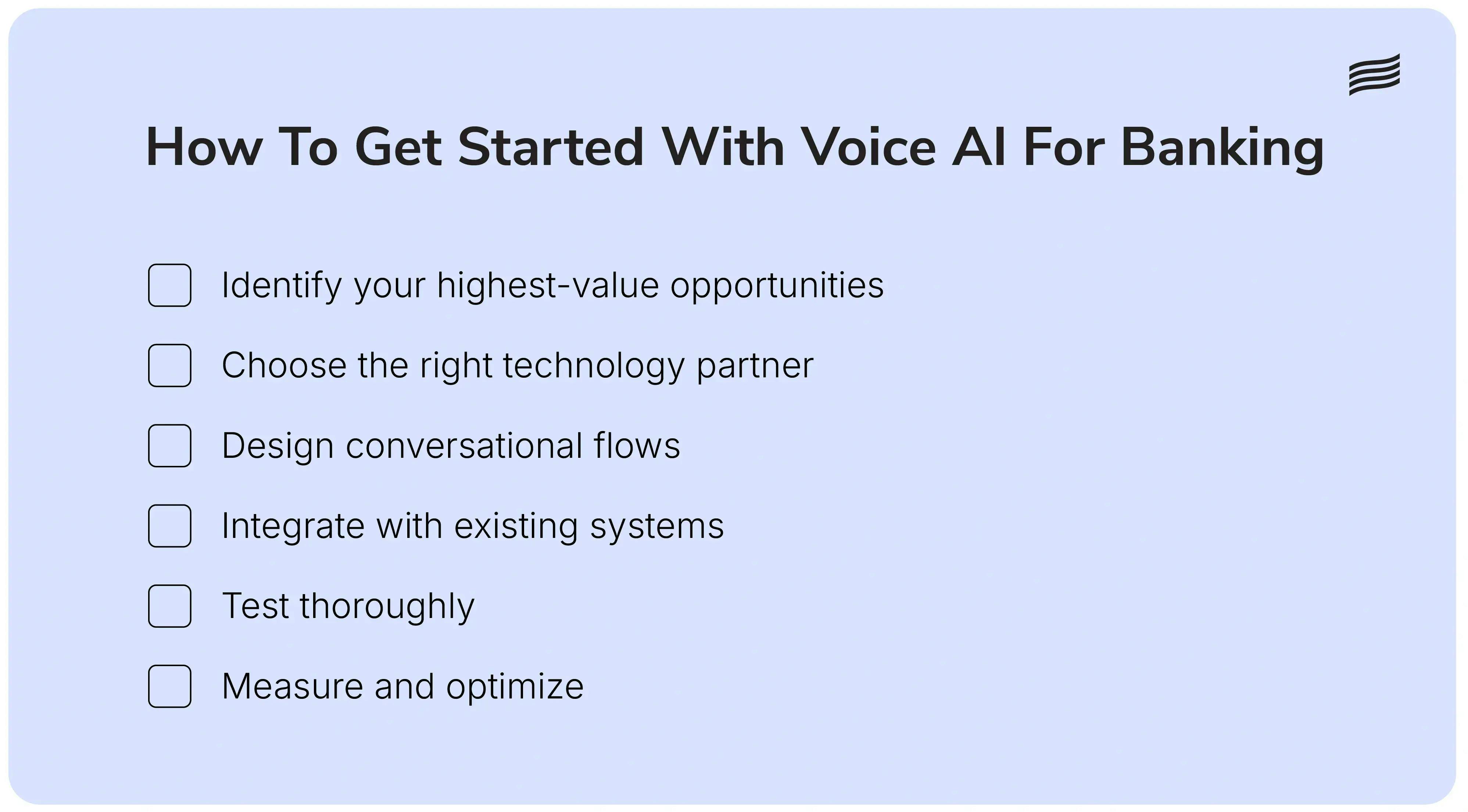
Implementing these Voice AI use cases doesn't have to be complicated. Here's a simplified approach:
- Identify your highest-value opportunities: Look for high-volume, routine interactions that would benefit from automation.
- Choose the right technology partner: Select a Voice AI platform with banking-specific features, including robust security and compliance capabilities.
- Design conversational flows: Create natural dialogues that reflect your brand voice while efficiently addressing customer needs.
- Integrate with existing systems: Connect your Voice AI solution with core banking systems, CRM, and other relevant platforms.
- Test thoroughly: Validate the system with real-world scenarios before full deployment.
- Measure and optimize: Track key metrics like completion rates, customer satisfaction, and operational savings to continuously improve.

Conclusion
The strategic implementation of Voice AI for banking delivers compelling benefits: reduced operational costs, enhanced customer experience, increased security, and improved efficiency. From payment collections to loan assistance, these five use cases demonstrate how Voice AI can transform banking operations while creating more meaningful customer relationships.
As customer expectations continue to evolve, banks that embrace Voice Agent will gain a significant competitive advantage through faster service, personalized interactions, and seamless experiences across all touchpoints. The future of banking is conversational, and that future is already here.
If you're looking to modernize your banking operations, boost customer engagement, and drive operational efficiency, it's time to explore how voice AI for banking companies can revolutionize your business.
Book a demo to find out!
Frequently Asked Questions
Yes, banks are allowed to use AI, and major regulators, including the FDIC, OCC, and FCA, actively publish AI guidance frameworks for responsible adoption. Banks must comply with data privacy laws, fair lending regulations, and explainability requirements when deploying tools like voice AI for banking companies across customer-facing operations.
Related Articles
The Smarter Way to Scale with AI Sales Outreach
Smarter AI sales outreach beats traditional hiring. Discover how to scale sales outreach with AI without the overhead of a massive team.
A Guide to Evaluating AI Voice Agents in 2026
Don't fall for the “Golden Demo.” Learn the 5 pillars for evaluating AI voice agents, from latency & ROI to agility & integrations.
Startup Challenges (And How Voice AI Resolves Them)
Learn how voice AI helps solve startup operational and growth challenges by replacing manual fixes and chaos with scalable, intelligent systems.