The Empathy Paradox: How AI Agents Are Becoming More "Human" Than Humans
Learn how human-like AI agents deliver more consistent and empathetic interactions than human representatives.





In an age where efficiency often trumps connection, something unexpected is happening in customer service. AI agents, once feared as cold and impersonal replacements for human representatives, are increasingly demonstrating qualities we’ve long considered uniquely human: consistency, patience, and yes, even a form of empathy that sometimes surpasses their human counterparts.
This emerging reality presents us with a fascinating paradox: machines designed to mimic human interaction are, in some ways, delivering more “human-like” experiences than overwhelmed, script-bound customer service representatives. As artificial intelligence evolves, the concept of a human-like AI agent is moving from science fiction to a daily reality for businesses.

The Evolution of Emotional Intelligence in AI
The journey of AI in customer service has evolved dramatically from the frustrating automated phone systems of yesteryear. Driven by technology advances in generative AI and natural language processing, today’s digital assistants do more than just follow scripts.
Today’s digital agents are sophisticated systems capable of contextual understanding, detecting emotional cues, and responding with appropriate tones and solutions. They utilize large language models to process human language with startling accuracy, transforming how customer support is delivered.
| Month | Savings |
|---|---|
| January | $250 |
| February | $80 |
| March | $420 |
From Recognition to Response
Modern AI doesn’t just process words; it analyzes sentiment, detects frustration in voices, and adjusts its approach accordingly. These systems can now:
- Identify emotional states through voice patterns, word choice, and typing speed
- Adapt responses based on detected customer sentiment
- Provide calming language during tense interactions
- Maintain consistent patience regardless of a customer’s emotional state
What makes this development particularly interesting is that AI doesn’t actually “feel” emotions; it recognizes and responds to them through machine learning pattern recognition and programmed responses. Yet paradoxically, unlike human workers, a human-like AI agent maintains consistent patience regardless of a customer’s emotional state.
Also read: AI Sales Outreach: The Smarter Alternative to Hiring SDRs
The Comparative Advantage: AI vs. Human Representatives
When we compare AI and human customer service representatives, some surprising patterns emerge regarding operational efficiency:
| Attribute | AI Agents | Human Representatives |
|---|---|---|
| Consistency | Maintains the same quality and tone across all interactions | Quality varies based on mood, fatigue, and personal circumstances |
| Patience | Unlimited patience without emotional fatigue | May become frustrated after repeated explanations |
| Availability | Real-time 24/7 service without breaks or downtime | Limited by working hours and need for rest |
| Emotional Baggage | No personal stress affecting interactions | May carry emotional residue from previous difficult calls |
| Memory | Perfect recall of customer history and preferences | May forget details or need to review information |
| Response Time | Immediate with no wait periods | Often delayed due to handling multiple customers |
Recent studies show that for routine tasks and straightforward service interactions, customer satisfaction scores for AI agents are beginning to surpass those of human representatives. Perhaps most surprisingly, the demographic most rapidly embracing agentic AI support is adults over 55, who particularly value the clarity, patience, and lack of judgment they experience.
The Ironic Empathy Gap
Here lies the paradox: AI agents, which fundamentally cannot experience emotions, are sometimes perceived as more empathetic than the human agent who can. How did we arrive at this counterintuitive reality?
The answer lies in the constraints of modern customer service environments and specific tasks:
- Time Pressure: Human agents are often evaluated on metrics like call duration, forcing them to rush through interactions to meet specific goal targets.
- Emotional Labor: The constant demand to manage one’s emotions while handling difficult customers leads to burnout.
- Script Constraints: Many human representatives are bound by rigid decision trees that limit natural responsiveness.
- Cognitive Overload: Agents juggle multiple systems, search engines, and data sources while trying to converse.
By contrast, virtual assistants and generative AI chatbots:
- Give customers their complete attention without time pressure
- Never experience emotional fatigue or judgment
- Can process customer history instantly to provide valuable insights
- Maintain a consistent tone regardless of the situation
“The irony is that AI doesn’t actually care about your problem, but it can give you its undivided attention in a way that makes you feel cared for.” This leads to higher user satisfaction and better customer experiences.
Also read: Manual vs Automated Calls in Startups: The Real Cost
The Human-AI Partnership: Finding Balance
Despite these advantages, AI still has significant limitations. It struggles with complex emotional nuance, cultural context, and unique situations outside its training data. Language models are improving, but human input is still vital.
The most effective service models today blend both traditional approaches and new ways:
- AI handles high-volume, repetitive tasks and information retrieval.
- Humans tackle complex or emotionally charged cases that require real person empathy.
- AI supports humans with live data and product recommendations.
- Seamless handoffs ensure quality across the user experience.
This partnership blends AI’s speed and reliability with human creativity and empathy. It allows for the deployment of AI to handle complex tasks while preserving human intervention for where it matters most.
| Also read: An Easy Guide to Evaluating AI Voice Agents

Ethical Considerations and Future Implications
As AI becomes more “human-like,” important ethical questions arise:
- Transparency: Should users always know they’re speaking to AI?
- Authentic Connection: Is something lost when we replace people with machines?
- Job Transformation: How should human roles evolve in AI-enhanced environments?
- Emotional Dependency: Will people begin to prefer infinitely patient machines over messy human connection?
Preparing for an Empathetic AI Future
To responsibly leverage AI in service and meet customer needs:
- Focus on augmentation, not replacement
- Design seamless handoffs between AI and humans
- Reserve human contact for high-value emotional touch points
- Train agents for emotional intelligence and complex problem-solving
- Measure outcomes, not just efficiency
Utilizing natural language generation allows for the best way of communication, but social media and traditional chatbots have shown us that contextual understanding is key.
Conclusion
The empathy paradox in customer service reveals something profound: people don’t just want human interaction; they want to feel understood and respected. Ironically, AI, when well-designed, may deliver that more consistently than people operating under stress and constraint.
The future of customer experience isn’t about choosing between the way humans work or AI, it’s about thoughtful collaboration between the two. By integrating a human-like AI agent into your workflow, you create customer journeys that are efficient yet personal, automated yet empathetic.
Ready to bridge the empathy gap? Empower your team with Ringg AI’s human-like agents for consistent, 24/7 support. Book a demo today to experience the future of customer connection.
We don't pitch AI hype.
We deliver business outcomes.
Frequently Asked Questions
While AI cannot "feel" emotions, it can simulate empathy through natural language processing and sentiment analysis. By recognizing emotional cues and responding with validated, supportive phrasing, a human-like AI agent can provide an experience that users perceive as empathetic, often more consistently than stressed human agents.
Related Articles
AI Call Personalization: A Guide To Turning Bot Calls Into Human-Like AI Calls
Discover how human-like AI calls and personalized voice AI boost engagement. Learn to use AI call personalization to reduce hang-ups through humanized AI voice calls for surveys, leads, and collections.
Bland AI Pricing: A Complete Breakdown For 2026
Understand why Bland AI costs more in production & how you can save more with Ringg AI.
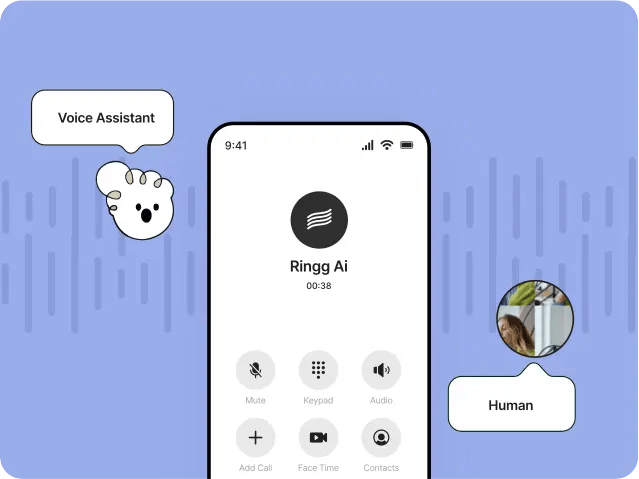
The Evolution of Voice Assistants from Commands to Conversations
Journey through the voice assistant timeline, from the 16-word IBM Shoebox to the sophisticated AI-driven interactions of today.