Gnani AI Reviews: Features, Pros, Cons, and Better Alternative
Gnani AI reviews are mixed. Here is what enterprise buyers need to know before signing the contract.





According to a recent Gartner forecast, over 70% of enterprise customer interactions will include some form of AI automation this year. For procurement teams evaluating voice AI assistants, the cost of choosing the wrong vendor has never been higher.
Gnani AI operates in the conversational automation market, focusing primarily on the Asian market and offering proprietary speech recognition for regional languages. It positions itself as a partner for large-scale banking and insurance enterprises that require specific on-premise deployments or support for niche dialects.
For businesses that prioritize speed and flexibility, Gnani AI reviews are often mixed. The platform functions as a managed service, requiring significant manual configuration and long deployment cycles. This traditional IT project approach contrasts sharply with modern SaaS platforms that allow teams to launch agents in days.
In this analysis, we will examine Gnani AI’s proprietary architecture, the operational friction users report, and the reasons agile enterprises are increasingly choosing Ringg AI for faster AI call automation.

What Is Gnani AI?
Gnani positions itself as a conversational AI platform designed to handle complex, multilingual interactions for large-scale enterprises.
Here are the key features you must note when analyzing any Gnani AI reviews:
- Proprietary Speech Engine: The platform relies on its own Automatic Speech Recognition (ASR) models instead of using open standards. This strategy aims for better accuracy when processing complex regional dialects and localized languages.
- Omnichannel Focus: It integrates voice, chat, and email automation into a single suite, targeting large contact centers that need a unified vendor. The platform serves customers in banking, fintech, telecom, and logistics across South Asia and select emerging markets.
- Managed Deployment: Unlike self-serve SaaS platforms, Gnani typically requires its internal engineering team to configure, train, and deploy agents for the client. This managed approach increases time-to-deployment and removes direct workflow control from the enterprise's own operations team.
Understanding how this architecture translates into real-world advantages requires a closer look at the platform's reported strengths.
What Are the Main Advantages of Gnani AI?
Reading recent Gnani AI reviews can help leaders understand its specialized regional strengths. Gnani AI offers specific features relevant to legacy banking institutions and government bodies with strict data residency requirements.
Here are its key advantages:
- Regional Language Focus: The platform supports 12 or more Indian languages, including code-mixed speech patterns, addressing specific needs in the regional banking and insurance sectors. Its proprietary ASR is trained on Indian accents, telecom-grade audio, and high-noise call environments.
- On-Premise Deployment: Gnani provides on-premises installation options, which are a firm requirement for certain public sector entities restricted from using shared cloud infrastructure. This capability positions the platform to meet the data sovereignty mandates of regulated government bodies and national financial institutions.
- Sector-Specific Models: The company uses pre-trained models for banking, insurance, and collections queries, reducing initial configuration time for common use cases. BFSI clients report that standard conversation flows can be deployed within the expected onboarding timeframe.
These advantages serve a well-defined segment, but they come with trade-offs that enterprise buyers encounter as they scale or modernize their operations.
What Are the Limitations of Gnani AI?
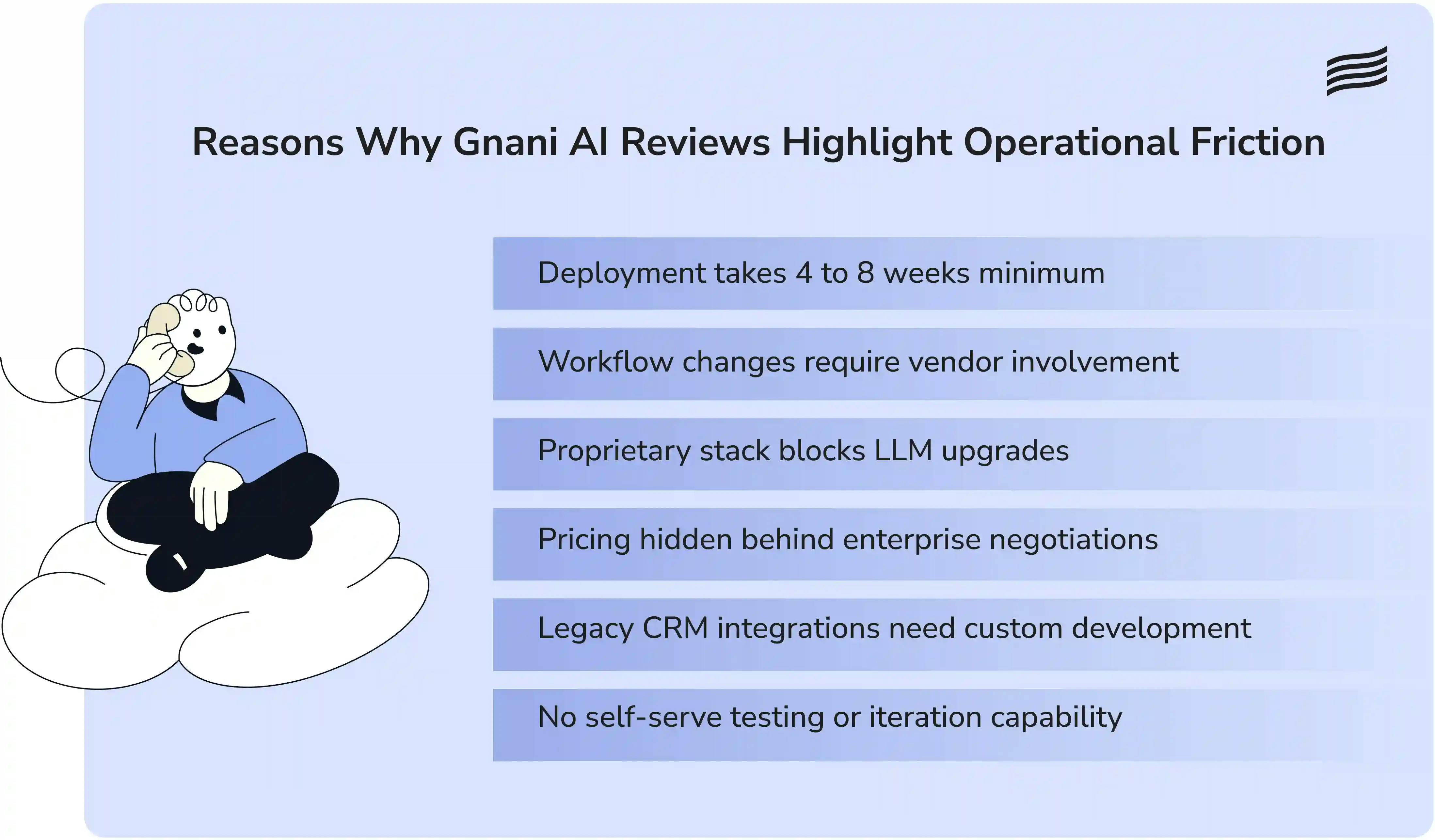
Despite its regional strengths, several Gnani AI reviews and user reports highlight significant operational friction for modern businesses.
- Slow Deployment: Implementations often take 4 to 8 weeks because the system relies on Gnani's internal teams for configuration rather than allowing clients to build independently. This dependency removes operational agility and creates bottlenecks each time a workflow needs updating or a new use case is introduced.
- Proprietary Lock-in: Users cannot easily switch to more capable LLMs such as GPT-4o or Claude because the platform is built on Gnani's own proprietary stack. This architecture limits how quickly enterprises can adopt better-performing AI models as the market continues to evolve.
- Cost Opacity: Custom enterprise quotes make it impossible for finance teams to calculate unit economics or model marginal costs without going through a lengthy sales negotiation process. Budget forecasting for Gnani AI deployments typically requires dedicated procurement resources and extended timelines.
- Integration Friction: Connecting to modern tech stacks outside of standard legacy banking CRMs often requires expensive professional services and extended development engagements. Teams using cloud-native tools report that API integrations demand significant additional investment beyond the base contract value.
These operational constraints directly affect cost and time-to-value, making Gnani AI pricing a critical factor in any serious vendor evaluation.
Gnani AI Pricing and Entry Costs
The company avoids publishing public pricing information. Industry data indicate a high cost of entry, suited exclusively to large enterprise budgets with substantial capital expenditure approvals.
Custom Enterprise Models
Gnani operates on a highly custom licensing model. Costs are negotiated based on total call volume and the number of regional languages required. Many Gnani AI Reviews note that this lack of transparency prevents agile teams from efficiently benchmarking costs against modern usage-based Gnani AI competitors. Operations leaders need clear financial predictability.
Implementation Fees
Businesses often face significant upfront implementation fees because deployments require intensive managed services. These initial costs cover the manual effort required to configure the proprietary models. Engineers must set up the initial conversational workflows by hand. This traditional deployment strategy consumes available enterprise innovation budgets early.
Hidden Maintenance Costs
Proprietary models require ongoing tuning to maintain accuracy as call patterns, language use, and product data change over time. Unlike open platforms, where model improvements deploy automatically, maintaining performance on a custom ASR stack typically incurs recurring professional services fees that add unpredictable cost to multi-year contracts.
Who Is Gnani AI Best Suited For?
Evaluating varied Gnani AI reviews helps users understand that the platform is designed for a specific segment of the market that prioritizes regional compliance and data sovereignty over speed.
- Best For: Large public sector banks and government bodies need on-premises deployment capabilities. These institutions require strict support for regional dialects and possess long timelines for enterprise software procurement.
- Less Suited For: High-growth enterprises, B2B SaaS companies, and operations teams that need rapid deployment, weekly iteration, and full workflow control will find the managed service structure too restrictive. Gnani AI is not designed for teams that require self-service speed or modern integration depth.
For teams that sit outside Gnani's defined buyer profile, the comparison between available alternatives becomes straightforward when measured against real operational requirements.
Why Ringg AI is an Agile Gnani AI Alternative?
Ringg AI is the AI voice agent platform that delivers enterprise-grade voice capabilities without the managed service overhead that defines most legacy platforms. Teams can launch, configure, and iterate voice agents independently using a visual builder, making it a strong alternative for operations-driven buyers who require speed and control.
Key Capabilities
- Visual Builder: Unlike Gnani's managed deployment approach, Ringg AI provides a no-code visual workflow builder that operations teams control entirely. Enterprises can configure and test booking flows in days without waiting on any vendor implementation team.
- Flash Latency: Our sub-400ms latency ensures fluid voice conversations that feel completely natural. This specialized telecommunications architecture outperforms legacy speech-recognition stacks and eliminates conversational pauses entirely.
- Open Intelligence: We orchestrate best-in-class models from OpenAI, Deepgram, and Anthropic instead of locking you into a proprietary stack. Your teams always have access to the most capable AI models available without renegotiating vendor contracts.

Pricing Overview
- Transparent Flat Rate: Ringg AI uses a simple per-minute rate. Our platform eliminates six-figure startup fees and hidden service retainers. You know exactly what your business will pay every single month.
- Linear Scaling: Costs scale directly with your actual software usage. This predictable structure makes budget forecasting simple and highly accurate for your corporate finance and operations teams.
Here are the key highlights of the Ringg AI pricing model:
| Feature | Flexible Usage Plan | Enterprise Plan |
|---|---|---|
| Price Per Minute | $0.10 / min (connected call) | $0.06 / min (connected call) |
| Concurrent Calls | Up to 50 | Up to 100 |
| Bulk Call Limit | 100 calls at a time | 10,000 calls at a time |
| Custom Number | $6/month | $6/month |
| Support & Integrations | Free Analytics | Priority Support + Custom Integrations |
Best For
Operations-driven companies in logistics, healthcare, and financial technology choose Ringg AI. These agile organizations need to deploy effective conversational automation immediately without undertaking a massive and expensive corporate consulting project.
Comparison: Gnani AI vs Ringg AI
Here is a comparative analysis of how each platform addresses the key requirements of enterprise voice automation deployment.
| Feature | Gnani AI | Ringg AI |
|---|---|---|
| Model | Managed Service (Consulting) | Voice Operating System (SaaS) |
| Deployment Time | 4–8 Weeks | Days |
| Workflow Control | Vendor-Managed (Closed) | User-Managed (Visual Builder) |
| Pricing | Custom Enterprise Contracts | Pay-As-You-Go / Flat Rate |
| Intelligence | Proprietary (Lock-in) | Open (Best-in-Class LLMs) |
Final Verdict: Is Gnani AI the Right Choice?
Analyzing comprehensive Gnani AI reviews confirms it serves a specific function. Heavily regulated Indian banking entities that require on-premises deployment benefit greatly. It operates as a traditional enterprise software implementation, perfectly suited for highly static corporate environments.
Modern businesses compete intensely on agility and operational efficiency. Ringg AI serves as the practical and superior alternative. You gain the direct tools to operationalize your voice support permanently, avoiding reliance on a slow managed service provider.
Stop waiting months for your voice automation deployment. Book a Ringg AI demo today to scale your operations.
We don't pitch AI hype.
We deliver business outcomes.
Frequently Asked Questions
Independent Gnani AI Reviews frequently mention its focus on enterprise customer service automation. The platform specializes in processing regional Asian languages and dialects. It provides voice and text solutions tailored for large banking institutions requiring complex on-premise software deployments.
Related Articles
Top 8 Bland AI Alternatives In 2026 (Reviewed and Compared)
Stop debugging experimental APIs. Discover reliable Bland AI alternatives built for enterprise scale, consistent latency, and transparent pricing models.
Honest Bland AI Review: Cost, Issues and Better Options
Stop gambling on viral beta tools. Discover why enterprise teams are switching from Bland AI to stable, transparent voice alternatives.
10 Best Sierra AI Competitors and Alternatives For 2026
Stop waiting for black-box consultants. Discover the top Sierra AI alternatives built for enterprise speed, transparent control, and rapid deployment.