10 Best No-Code AI Voice Agents In 2026 (Rated and Reviewed)
Wondering which no-code AI voice agent is right for your business in 2026? Here are 10 leading platforms compared across various parameters to help you choose.





Launching an AI voice agent in the past meant assembling a team of engineers, stitching together speech APIs, managing infrastructure, and praying nothing breaks in production. In 2026, that playbook is officially outdated. Now is the era of no-code AI voice agents. Even non-technical professionals like marketers, sales specialists, and support teams can design and deploy intelligent voice agents using drag-and-drop builders today.
Now, the market is inundated with no-code AI voice agent builders that let you build AI voice agents in minutes. More choice is always great, but it also makes selecting the right solution for your business far more difficult. To make that decision easier, we have compiled this carefully evaluated list of the 10 best no-code voice AI platforms of 2026.
What is a No-Code AI Voice Agent?
A no-code AI voice agent is a conversational AI system that allows you to design and deploy automated voice interactions without writing any code. Instead of building complex backend logic or integrating multiple APIs manually, you can create conversational flows through drag-and-drop builders. These builders allow you to define prompts, set conditions, and even configure integrations using simple workflow blocks.
Behind these intuitive dashboards sits a powerful technology stack. Top no-code voice AI agents combine:
- Automatic speech recognition to convert speech into text
- Natural language processing to understand intent and context
- Text-to-speech engines to generate human-like responses.
They also handle telephony infrastructure, call routing, recording, and CRM integrations in the background.
What are the Benefits of Using a No-Code AI Voice Agent?
The most immediate advantage of a no-code AI voice agent platform is reduced reliance on engineering resources. This shift then creates a ripple effect of additional benefits, which makes the creation and management of your AI voice agent more efficient. Here’s how that happens:
- Faster Deployment: Launch voice agents in days instead of months.
- Lower Development Costs: Minimize engineering effort and infrastructure overhead.
- Reduced Technical Dependency: Let operations and marketing teams manage flows independently.
- Rapid Experimentation: Test and iterate workflows quickly.
- Scalability: Handle increasing call volumes without rebuilding infrastructure.
- Easier Integrations: Connect with CRMs and telephony systems with minimal setup.
10 Best No-Code AI Voice Agents in 2026
Building a production-ready AI voice agent no longer requires engineers. These 10 top no-code voice AI platforms let you design and deploy with drag-and-drop simplicity.
TL;DR
| Platform | Key Feature | G2 Rating |
|---|---|---|
| Ringg AI | Ease of building an AI agent, deployment in minutes | 4.8/5 |
| Voiceflow | Intuitive interface | 4.6/5 |
| Synthflow | Ease-of-use | 4.5/5 |
| Plivo | Multichannel support | 4.5/5 |
| Haptik AI | Omnichannel messaging | 4.5/5 |
Winner: Ringg AI stands out as the premier no-code solution by allowing operations teams to deploy complex call workflows in minutes using an intuitive drag-and-drop builder. It perfectly balances this true no-code simplicity with robust enterprise infrastructure.
1. Ringg AI
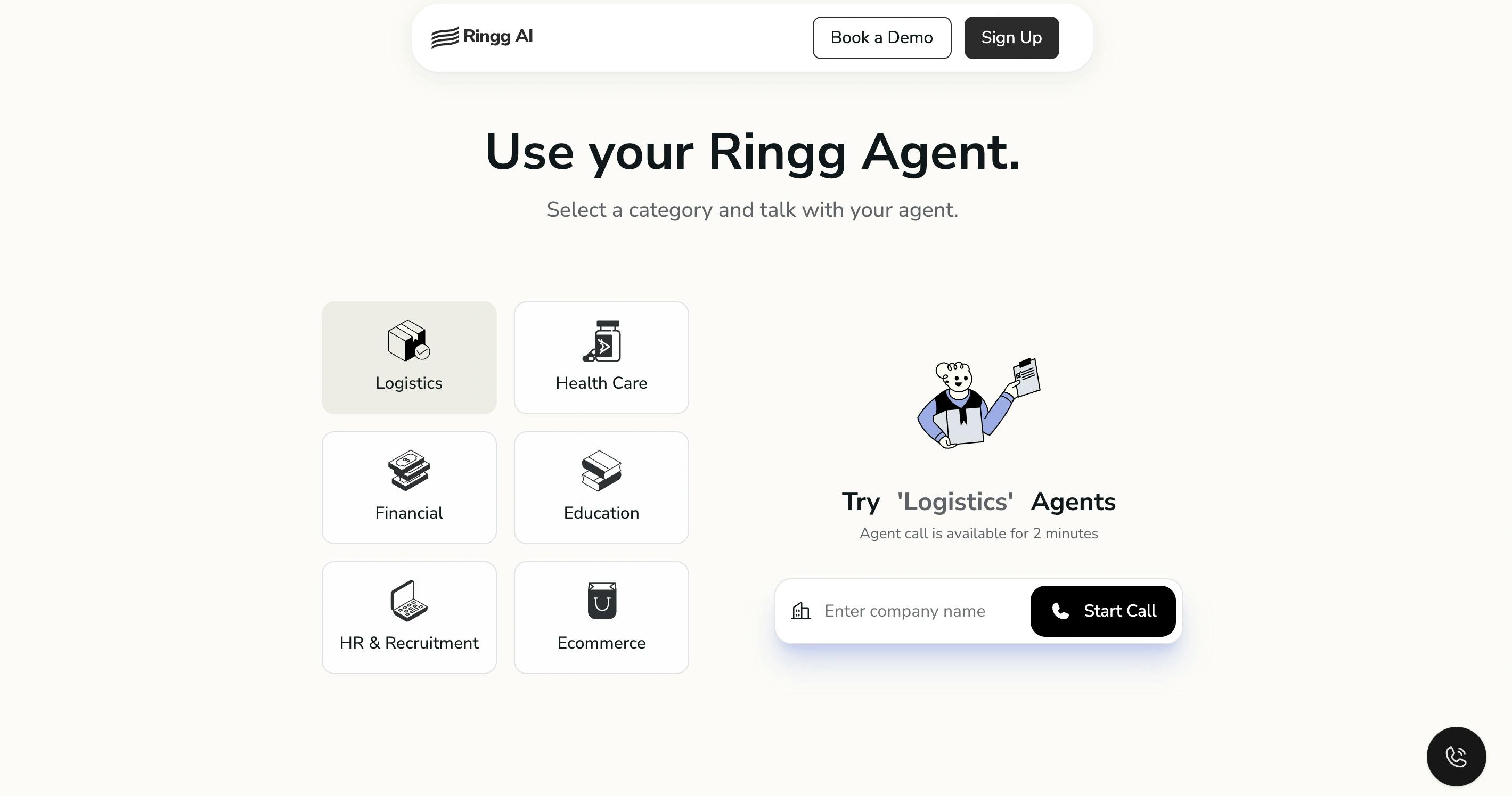
Ringg AI is one of the best no-code Voice AI builders that automates your inbound and outbound business calls. It offers a seamless ecosystem for your team to design intelligent voice assistants using a drag-and-drop builder. There are no heavy engineering dependencies, but at the same time, the platform supports deep integrations through APIs and webhooks, if required. With sub-400ms latency, multilingual support across 20+ languages, and the ability to handle large-scale concurrent calling, Ringg AI is designed for operational reliability and real-time responsiveness.
From lead qualification and collections to appointment reminders and customer support, Ringg AI supports dynamic call flows, CRM synchronization, real-time analytics, and seamless human handoffs. It can be tailored to a variety of industries, including BFSI, healthcare, logistics, e-commerce, and education.
Key Features
- Intelligent Number & Campaign Control: Instantly get local, toll-free, or mobile numbers and assign them to specific assistants or campaigns. Monitor usage, track performance, and manage all call activity from a centralized dashboard.
- Full Conversation Visibility: Access detailed transcripts, recordings, call outcomes, and decision paths in one place. Filter interactions by customer, assistant, time, or disposition to maintain complete operational context and audit readiness.
- Adaptive Knowledge & Personalization Engine: Upload FAQs, SOPs, and documents to power responses. Use dynamic variables for personalized conversations and update knowledge instantly without rebuilding workflows.
- High-Volume Campaign Automation: Launch and manage large-scale outbound campaigns with smart retry logic, targeting rules, and real-time branching flows. Track engagement, drop-offs, and conversions through built-in analytics.
Who Can Use Ringg AI and How?
- Hotels & Travel: Front desk managers can use the intuitive drag-and-drop builder to instantly deploy AI agents that handle room booking inquiries, answer standard FAQs (like check-in times or parking rules), and provide seamless multilingual support for international guests without ever needing to submit an IT ticket.
- Hiring: Recruiting teams can effortlessly launch high-volume outbound calling campaigns to automatically screen hundreds of applicants, verify basic qualifications, and schedule first-round interviews directly into the team's calendar, drastically reducing the manual burden of top-of-funnel hiring.
- Restaurants: Restaurant operators can quickly upload their menus, dietary info, and operating hours into the platform's dynamic knowledge base. The AI can then autonomously handle peak-hour table reservations, answer menu questions, and route VIP callers, ensuring no revenue is lost to missed calls during the dinner rush.
- Healthcare & Clinics: Clinic administrators can easily map out call routing logic to automate routine patient interactions. The AI voice agent can book and reschedule appointments, deliver routine care reminders, and answer basic clinic FAQs with sub-400ms latency, freeing up front-desk staff to focus entirely on in-person patient care.
Pricing
Ringg AI follows a transparent, usage-based pricing model billed per connected call minute, covering telephony, AI processing, and transcription.
- Enterprise Plan: Starts at $0.06 per connected call per minute.
- Flexible Usage Plan: Starts at $0.10 per connected call per minute.

2. Voiceflow
Source: Voiceflow website
Voiceflow is a collaborative platform for building AI voice agents. It supports multiple AI models, including OpenAI and Anthropic. The platform provides tools for workflow design, content management, custom code integrations, and secure API handling. Designed for enterprise environments, Voiceflow includes staging pipelines, SSO, and centralized governance to help you develop and deploy AI agents without complications.
Key Features
- Knowledge Base Integration: Import documents and data to allow agents to generate responses based on curated sources.
- Workflow Builder: Create multi-step tasks and structured logic using Voiceflow’s workflow tools.
- Flexible Deployment: Launch agents via Voiceflow’s web chat interface or integrate into custom applications using an API.
Pricing
Need to book a demo for pricing details.
Where Voiceflow Lacks
- Not built for native telephony: Voiceflow is primarily a conversation design canvas; it relies on third-party voice execution platforms to actually place calls, adding complexity to your tech stack.
- Adds integration latency: Because it acts as a middleman passing data to a telephony layer and back, it introduces multi-hop API latency that disrupts the natural flow of a live phone call.
- Rapidly scaling runtime costs: While the design tools are accessible, the runtime execution costs scale quickly and unpredictably as your conversational volume increases.
Why Ringg AI is better than Voiceflow
Voiceflow requires you to stitch together separate design and telephony vendors, introducing lag. Ringg AI is an all-in-one Voice OS with native telephony built directly into the visual workflow engine, guaranteeing sub-400ms latency and a single point of accountability.
Read Also - AI Customer Service
3. Edesy
Source: Edesy website
Edesy is the next voice AI platform that lets you build voice agents without writing any code. It offers multi-provider support for STT (Speech-to-Text), TTS (Text-to-Speech), and LLMs. It supports 13+ languages, including 10 Indian languages, and integrates with telephony providers such as Twilio, Exotel, and Plivo. With options for self-hosted deployment and flexible provider switching, Edesy lets you configure, connect, train, and launch voice AI systems according to your infrastructure needs.
Key Features
- Advanced Call Analytics: Provides real-time transcription, sentiment analysis, topic detection, quality scoring, and agent performance insights.
- Gemini Live Audio Processing: Utilizes native audio AI that processes speech directly without traditional STT to LLM to TTS conversion.
- Multi-Provider Flexibility: Supports integration with multiple STT, TTS, and LLM providers, allowing you to select models based on performance and use case.
Pricing
Since pricing is not publicly available on its website, businesses need to contact the sales team or book a demo for a quote based on usage, integrations, and business needs.
Where Edesy Lacks
- Inconsistent latency: Users report noticeable variations in latency, which instantly breaks the illusion of a human conversation during live calls.
- Poor global language support: While it handles Indic languages well, it lacks robust optimization for non-Indic and international languages, limiting global scalability.
- Steep learning curve: Despite being marketed as a no-code tool, setting up multi-provider integrations and routing requires significant technical context.
Why Ringg AI is better than Edesy
While Edesy suffers from unpredictable latency spikes and a steep learning curve, Ringg AI guarantees ultra-low, sub-400ms response times globally and features a genuinely intuitive drag-and-drop builder that any operations manager can master in minutes.
4. Synthflow
Source: Synthflow website
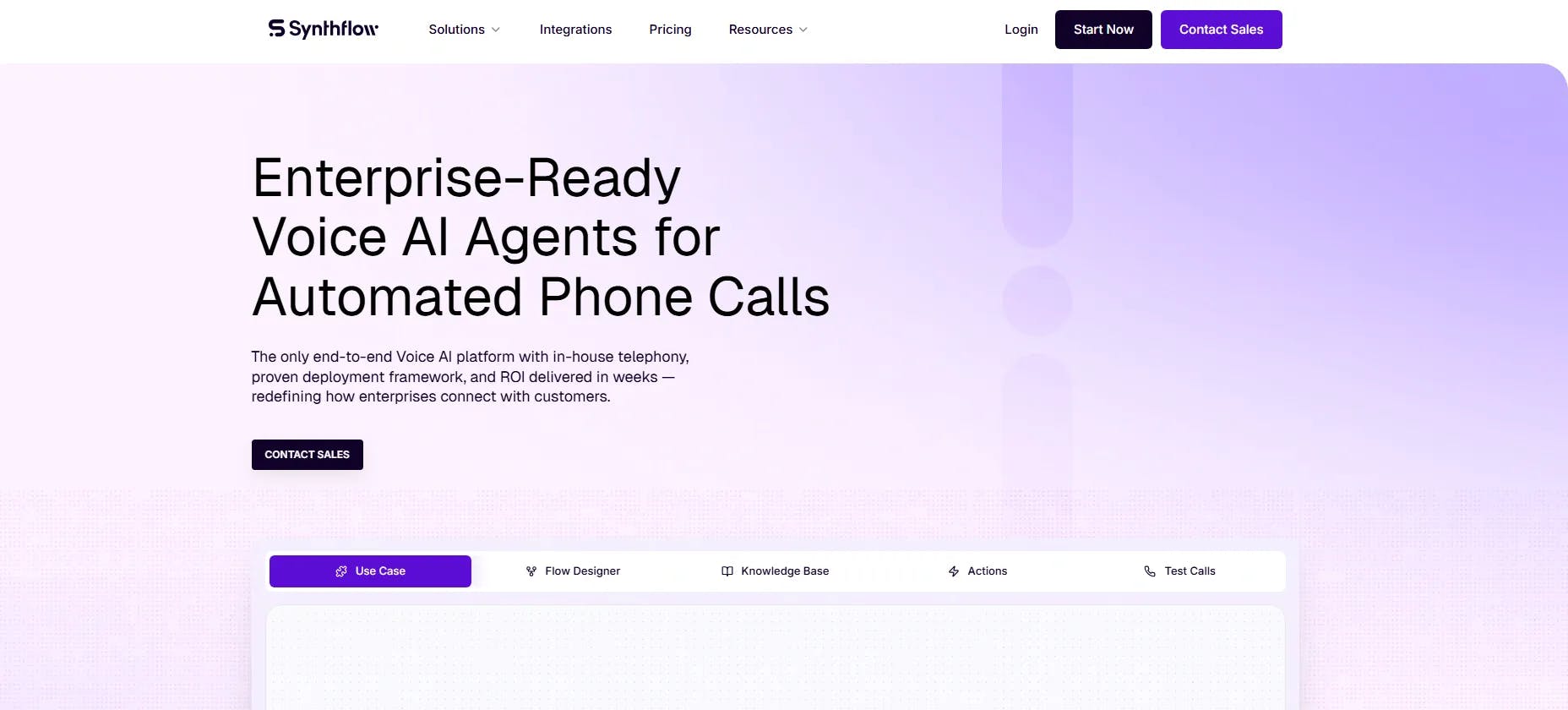
Synthflow is a no-code voice AI platform that offers a visual Flow Designer through which you can build voice flows aligned with your business logic and define precise call handling steps. You can create and manage voice agents, define call flows, configure handoffs, and customize responses through templates or fully custom workflows. Deployment runs through Synthflow’s telephony network, with controlled routing and delivery.
Key Features
- Multi-Agent System: Create modular voice flows using a no-code builder, with subflows that function as specialized agents for managing complex logic.
- AI Sandbox for Testing: Test, compare, and version agents in a controlled environment, with the ability to roll back and deploy updates without downtime.
- Real-Time Monitoring: Access live visibility into calls, webhooks, and APIs to support debugging and performance tracking.
Pricing
Offers usage-based pay-as-you-go and enterprise subscription tiers for startups and growing teams. The exact price isn’t disclosed on their website.
Where Synthflow Lacks
- Incapable of handling complex logic: The drag-and-drop builder is highly simplified, making it impossible to orchestrate the complex, multi-step APIs required for enterprise workflows.
- Severe concurrency limits: It enforces strict subscription limits on concurrent calls, making it entirely unsuitable for handling high-volume or seasonal call spikes.
- Missing enterprise security: It lacks the robust, out-of-the-box data security certifications required to handle sensitive customer data at scale.
Why Ringg AI is better than Synthflow
Synthflow is limited to simple SMB tasks like basic appointment booking. Ringg AI is built for true enterprise scale, offering unlimited concurrency and deep CRM integrations to power complex workflows like logistics routing and secure fintech collections.
5. Plivo
Source: Plivo website
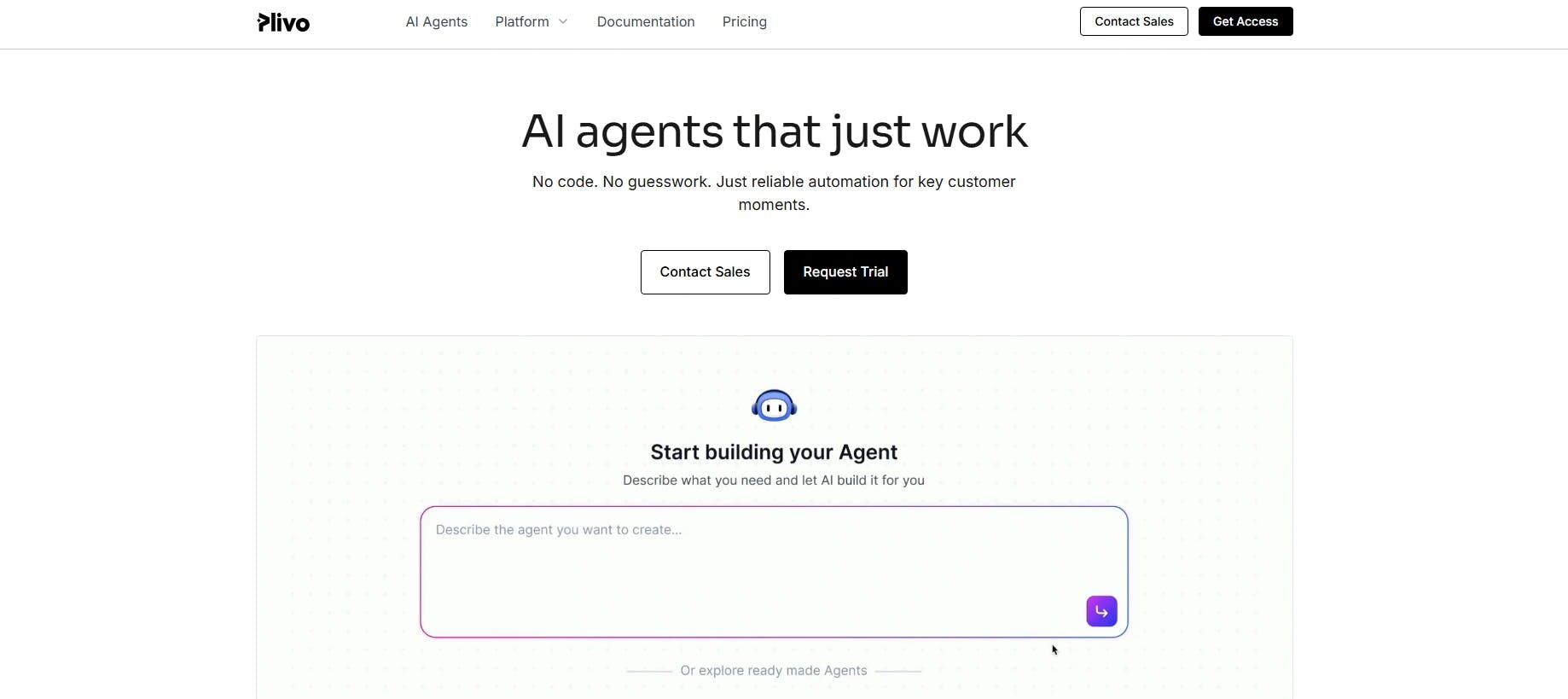
Plivo offers a no-code AI agent platform that lets you launch voice, chat, SMS, and WhatsApp agents through a guided interface. The platform supports integrations with tools such as CRMs, e-commerce platforms, helpdesks, and calendars, allowing agents to take real actions within existing systems. With multimodal capabilities and human handoff options, Plivo focuses on AI automation for common customer interactions like lead capture, support, booking, and surveys.
Key Features
- Pre-Built Integrations: Supports API-based and MCP integrations, enabling agents to interact with CRMs, helpdesks, e-commerce platforms, and productivity tools.
- Brand-Aligned, Data-Grounded Conversations: Adapts to your brand voice while retrieving responses from connected knowledge bases and data sources.
- Security-First Architecture: Provides end-to-end encryption, role-based access controls, and regular security audits to protect data.
Pricing
Plivo offers a pay-as-you-go pricing model with usage-based billing for AI agents and communication channels.
Where Plivo Lacks
- High conversational latency: At roughly 500ms, Plivo’s latency is noticeably higher than modern standards, resulting in awkward pauses during live customer interactions.
- Limited language options: It supports a mere 10 languages, drastically bottlenecking companies looking to scale across diverse regional and international markets.
- Complex pricing constraints: The pay-as-you-go model comes with restrictive concurrency caps (e.g., 50 calls), forcing enterprises into complicated, expensive upgrades just to handle basic scale.
Why Ringg AI is better than Plivo
Plivo’s 500ms latency and severe 10-language limit create immediate bottlenecks. Ringg AI delivers industry-leading sub-400ms latency and seamlessly supports over 70+ languages and 16+ regional Indian dialects, ensuring fluid scale without arbitrary concurrency caps.
6. Bolna
Source: Bolna website
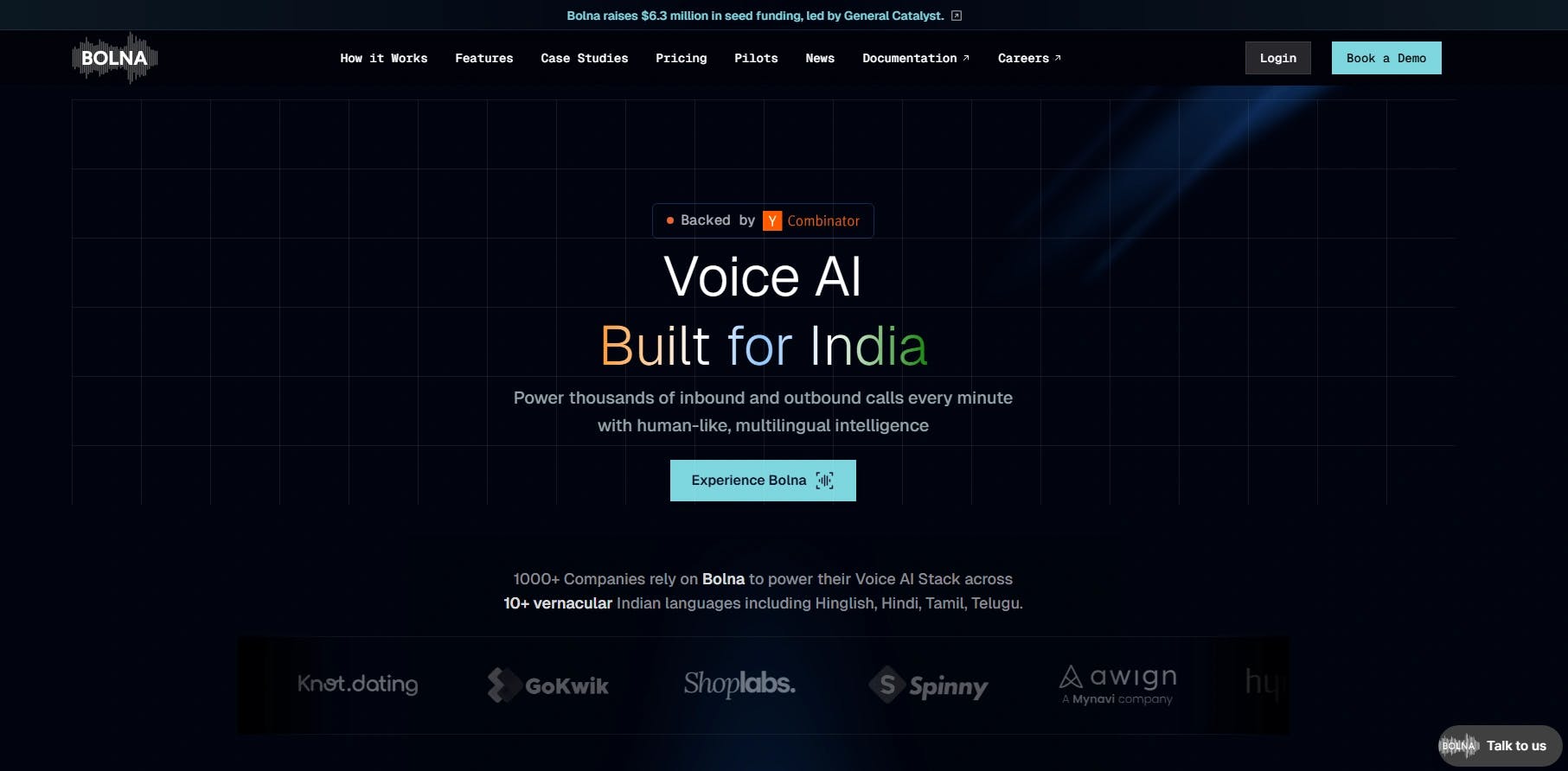
Bolna AI is a no-code Voice AI platform with a strong focus on Indian languages and use cases. It allows you to configure agents through a dashboard, trigger bulk campaigns, and integrate telephony and APIs without extensive setup time. The platform supports 10+ vernacular Indian languages, real-time API calls during conversations, human handoff, and workflow integrations with tools like Zapier and n8n.
Key Features
- Bulk Calling: Supports simultaneous outbound or inbound AI-driven calls across large customer volumes.
- Custom API Triggers: Allows the voice agent to connect with external systems through APIs during an active conversation.
- Human-in-the-Loop: Provides the ability to transfer conversations from the AI system to a human agent when required.
Pricing
Bolna pricing follows a pay-as-you-go pricing model alongside pilot and enterprise plans. Usage-based pricing starts at approximately 6¢ per minute, while the Pilots Plan includes up to 100 concurrent calls with fixed volume-based pricing.
7. Telnyx
Source:Telnyx website
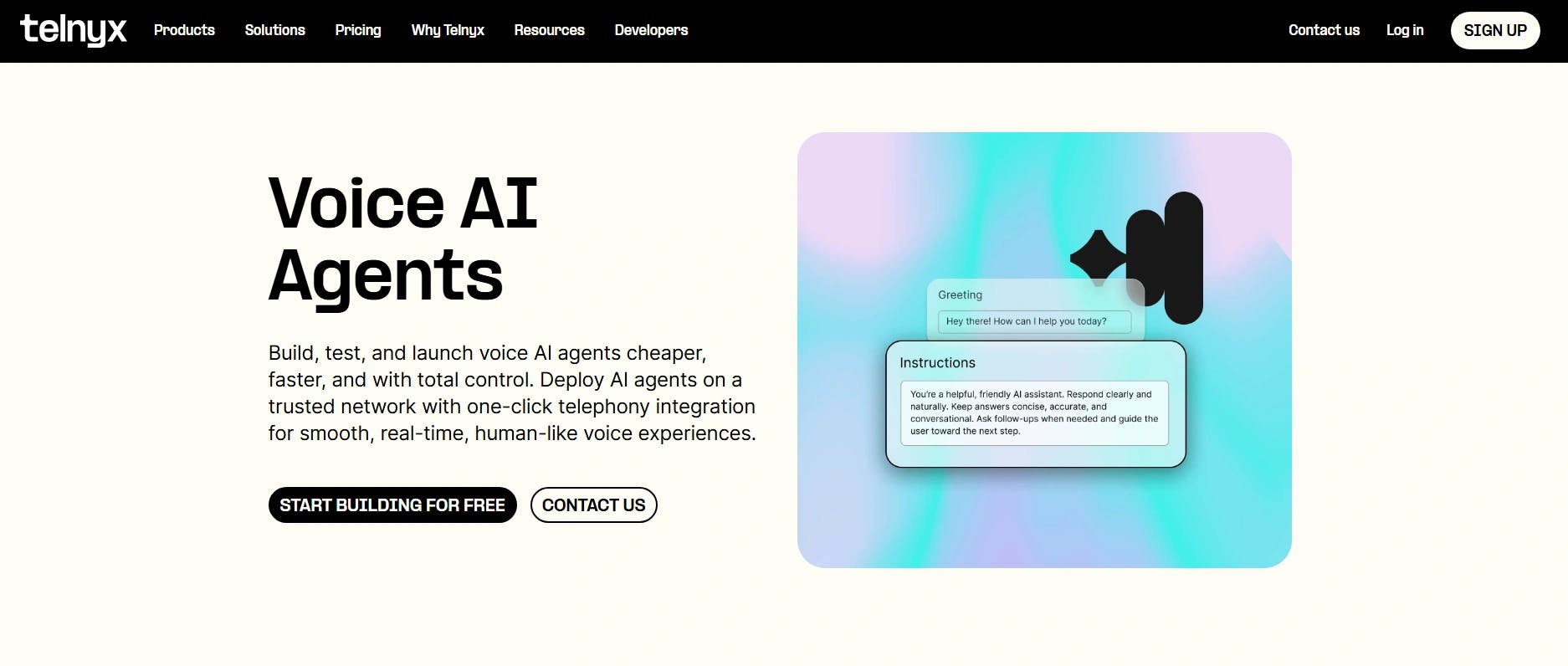
Telnyx is a full-stack communications platform offering voice AI agents built on its own carrier-grade network. Telnyx supports low-latency, real-time voice interactions with direct call control. The platform provides both a no-code builder within its Mission Control Portal and flexible APIs for developers who need customization at scale.
Key Features
- Multi-Agent Handoffs: Allows call transfers and coordinated conversations across multiple AI agents within a single interaction.
- Comprehensive Testing: Run automated multi-path simulations and tests to evaluate accuracy and response quality before deployment.
- Agent Migration Support: Import existing voice agents from other platforms. You can reuse flows, scripts, and configurations without rebuilding.
Pricing
The platform uses a pay-as-you-go pricing model, with Voice AI pricing starting at approximately $0.05 per minute, depending on usage and selected services.
Where Telnyx Lacks
- Developer-centric complexity: The platform heavily favors APIs and developer tools, making its "no-code" interface clunky and difficult for standard operations managers to navigate.
- Performance under pressure: Users report occasional latency spikes and conversational delays during high-traffic periods, impacting customer experience.
- Confusing pricing add-ons: The base conversational rate is just the start; the pricing model becomes highly complicated with multiple separate add-ons for necessary telephony features.
Why Ringg AI is better than Telnyx
Telnyx is built for developers and struggles with latency under load. Ringg AI is built specifically for operations teams, offering an easy-to-use visual dashboard, guaranteed high-volume stability, and a simple, all-inclusive pricing model with zero hidden add-ons.
8. Dograh
Source: Dograh website
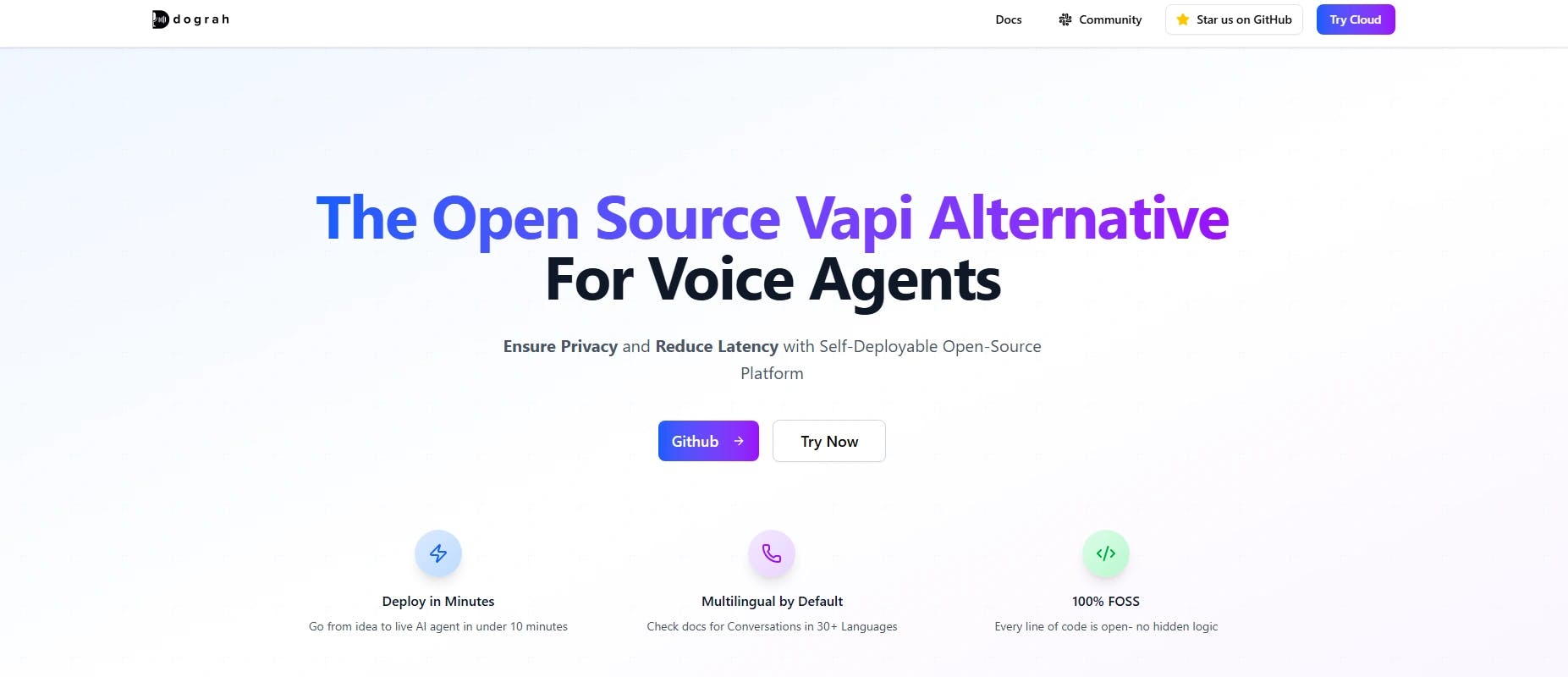
Dograh Voice Agent is an open-source platform for creating AI voice agents. It is a self-deployable alternative to proprietary solutions. The platform allows full access to source code, allowing you to self-host for better control. Dograh includes a no-code drag-and-drop builder, telephony integration, multilingual support across 30+ languages, and observability tools such as Langfuse.
Key Features
- Voice Customization: Select from multiple voice profiles or create custom voices aligned with your brand identity.
- Intelligent Routing: Automatically transfer complex or sensitive queries to human agents when required.
- AI-Powered Insights: Analyze conversation data to identify trends, customer needs, and performance insights.
Pricing
It is an open-source platform
Where Dograh Lacks
- Massive DevOps burden: As an open-source platform, you are entirely responsible for self-hosting, server maintenance, scaling infrastructure, and ensuring uptime.
- Data security risks: Without managed enterprise compliance (like SOC-2), using an open-source tool for sensitive customer conversations introduces severe data privacy concerns.
- Weak native integrations: Integrating with third-party CRMs and tools requires heavy manual API and webhook development, as it lacks plug-and-play connectors.
Why Ringg AI is better than Dograh
Dograh forces your engineering team to become full-time server admins. Ringg AI eliminates the DevOps headache entirely by providing a fully managed, SOC-2 compliant platform with native, one-click CRM integrations out of the box.
9. Haptik AI
Source: Haptik AI website
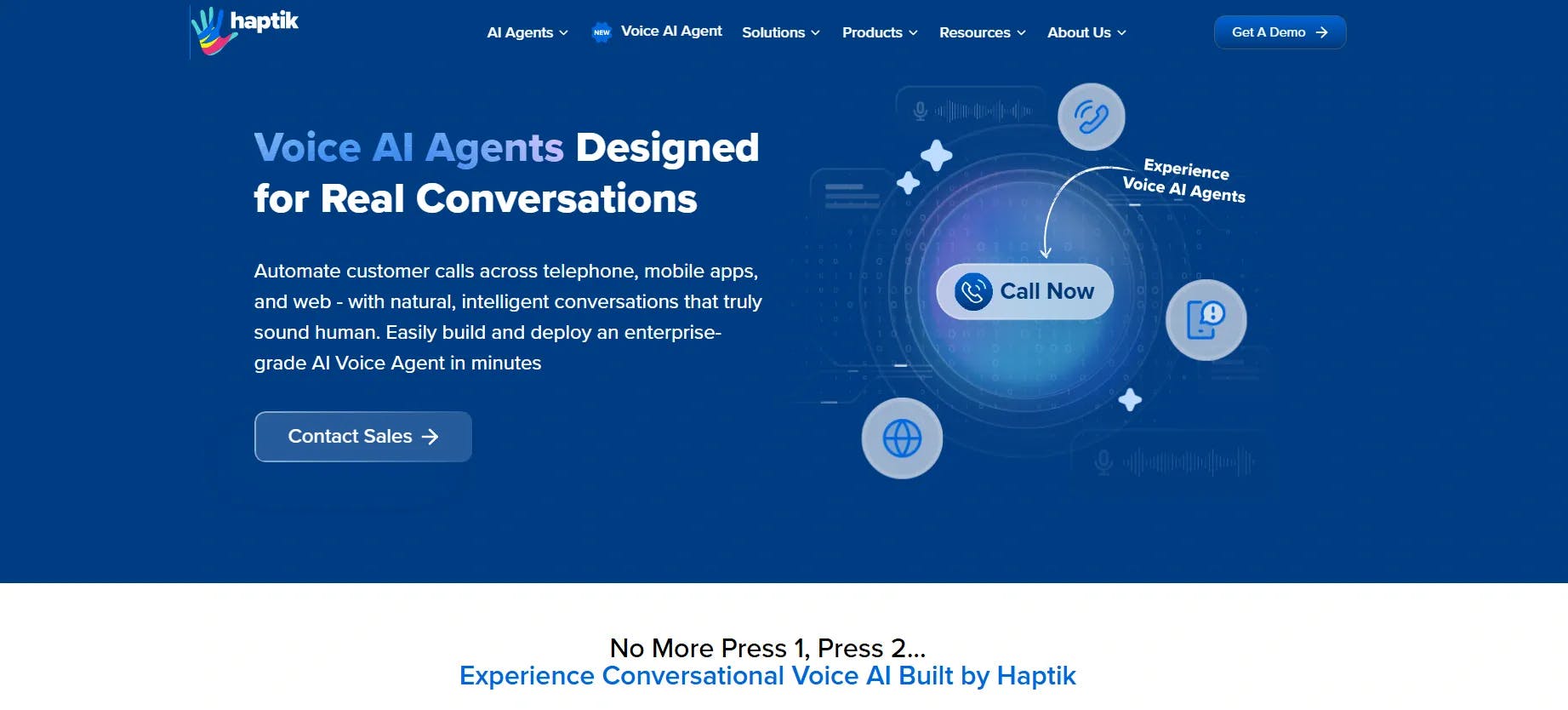
Haptik provides enterprise Voice AI Agents that integrate with your existing business systems. The platform is designed with security and compliance in mind, supporting standards such as GDPR, CCPA, and ISO, along with PII protection and end-to-end encryption. In addition to a no-code builder, it allows you to connect your own LLMs, use REST APIs, and build on top of existing knowledge bases without vendor lock-in.
Key Features
- Voice Customization: Configure tone, gender, accent, and voice depth to match your brand identity.
- Analytics and Insights: Get actionable analytics to improve service quality, monitor performance, and support SLA compliance.
- Built-In Handover: Automatically transfers calls to live agents with intent detection and conversation summaries when human support is required.
Pricing
Where Haptik AI Lacks
- Inconsistent voice quality: The realism and natural cadence of their synthesized voices can vary significantly, occasionally breaking the illusion of speaking with a human.
- Rigid template flows: The platform relies heavily on rigid, pre-built templates, restricting the ability to build highly custom, dynamic conversational logic.
- Limited global localization: While strong in regional NLP, it lacks the deep, nuanced dialect support required for truly global, cross-border deployments.
Why Ringg AI is better than Haptik AI
Haptik locks you into rigid templates with inconsistent audio quality. Ringg AI gives you total control via a flexible drag-and-drop workflow builder, backed by hyper-realistic, sub-400ms voices that sound perfectly native across global and regional dialects.
10. Awaz
Source: Awaz website
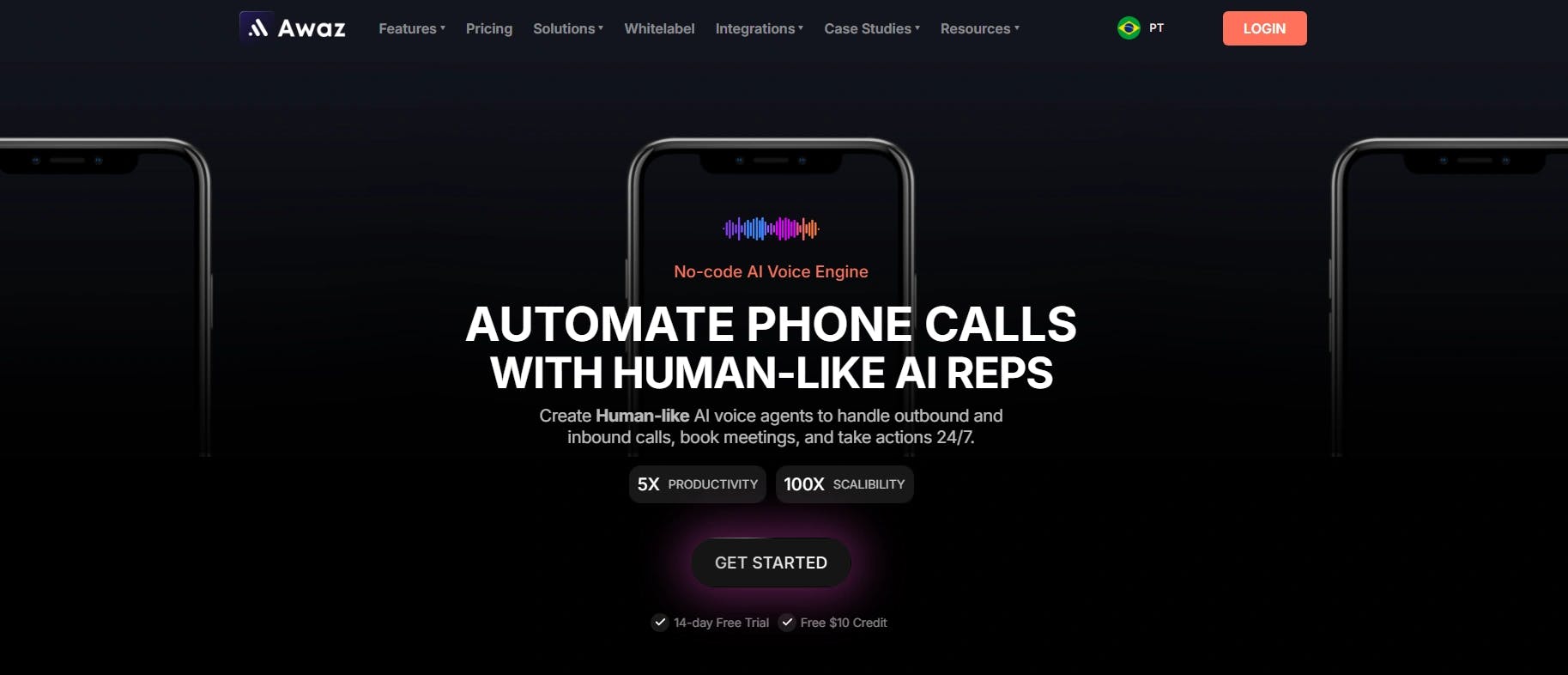
Awaz.ai is a no-code AI voice agent platform that lets you build and deploy human-like voice assistants to automate inbound and outbound phone calls without technical skills. The platform supports 24/7 customer interactions such as booking appointments, qualifying leads, and handling support, using natural conversational AI. It also integrates with calendars, CRM, SMS, and workflow tools for improved automation.
Key Features
- Sentiment Monitoring and Performance Analytics: Built-in tools help analyze conversations by tracking sentiment trends and overall call outcomes.
- Centralized Knowledge Management: Upload and organize documents and training materials with up to 30GB storage per knowledge base to support structured agent responses.
- Configurable Workflow Builder: Create conditional logic and structured workflows that align with your operational processes.
Pricing
There are 3 main plans, with the Starter Plan costing $29/month. It supports 5 agents, 3 users, 3 calendars, unlimited SMS and WhatsApp, and core integrations at $0.40 per minute call.
Where Awaz Lacks
- Severe multilingual limitations: It completely fails to address diverse markets, lacking the robust language and dialect support required for national or global scaling.
- Not built for high-volume scale: The infrastructure and concurrent call limits make it entirely unsuitable for large enterprises executing massive outbound campaigns.
- Hidden costs for core features: Essential operational necessities—like dedicated phone numbers and extended knowledge base usage—incur frustrating additional costs on top of the base subscription.
Why Ringg AI is better than Awaz
Awaz is built for small-scale local businesses and falls apart under enterprise volume. Ringg AI scales infinitely, natively handles 16+ complex Indian dialects and mixed languages, and includes all core telephony features in its flat-rate pricing.

How to Pick the Right No-Code AI Voice Agent?
Choosing a no-code AI voice agent is all about finding a platform that your team can actually build, launch, scale, and manage without engineering bottlenecks. Use this practical checklist to evaluate your options before you commit:
Ultimate No-Code AI Voice Agent Evaluation Checklist
Workflow Builder Simplicity
☐ Can non-technical users design and edit call flows easily?
☐ Is the interface visual and intuitive, not script-heavy?
True No-Code or Hidden Technical Setup?
☐ Is deployment genuinely self-serve?
☐ Are integrations plug-and-play or developer-dependent?
AI Conversation Quality
☐ Does it handle interruptions and natural back-and-forth dialogue?
☐ Can it manage multilingual or regional language conversations?
Integration Capabilities
☐ Does it connect seamlessly with your CRM?
☐ Are webhooks and APIs available if needed?
Customization Flexibility
☐ Can you customize tone, scripts, and logic flows?
☐ Does it support dynamic responses based on user data?
Scalability
☐ Can it handle higher concurrent calls without performance issues?
☐ Does it maintain low latency during peak traffic?
Pricing Transparency
☐ Is pricing clearly usage-based or tier-based?
☐ Are there hidden costs for concurrency, integrations, or compliance?
Support & Reliability
☐ Is onboarding support available?
☐ Do they provide technical documentation and real-time assistance?
If a platform checks most of these boxes, you are not just buying a voice agent. You are investing in a system your team can confidently operate and scale.
How Ringg AI Masters No-Code Scalability
Ringg AI is one platform that checks all the above boxes by combining a true no-code builder with enterprise-grade performance and infrastructure. The platform allows your operations, sales, and support teams to design structured voice workflows aligned with business logic, without relying heavily on engineering resources. With sub-400ms latency, high-concurrency outbound capabilities, and detailed call analytics, Ringg AI is built to handle both complexity and scale. If you are evaluating no-code voice AI platforms for long-term growth, book a demo to see how Ringg AI can fit into your workflows.
--
Frequently Asked Questions
Ringg AI is well-suited for contact center integrations due to its REST APIs, webhook support, CRM sync capabilities, and seamless human handoff with full context retention. It integrates into your existing tech stacks without requiring infrastructure changes, making it practical for contact centers managing high call volumes across sales, customer service, and lead generation workflows.
Related Articles
8 Best AI Voice Assistants For Enterprises in 2026
Discover the best AI voice assistants for enterprises. Here are the top 8 platforms for latency, reliability & operational control.
A Guide to Evaluating AI Voice Agents in 2026
Don't fall for the “Golden Demo.” Learn the 5 pillars for evaluating AI voice agents, from latency & ROI to agility & integrations.
AI Call Personalization: A Guide To Turning Bot Calls Into Human-Like AI Calls
Discover how human-like AI calls and personalized voice AI boost engagement. Learn to use AI call personalization to reduce hang-ups through humanized AI voice calls for surveys, leads, and collections.