Decagon AI Pricing: How Much Does It Cost in 2026?
Decagon AI pricing is never listed publicly. Here is what enterprise buyers should know before booking that demo.





Decagon AI has established itself as a player in the customer support automation space, targeting large enterprises with high ticket volumes. If you are researching Decagon AI pricing, you have likely noticed a consistent pattern: there are no numbers on their website, only a button to book a demo.
This is standard practice for enterprise-grade solutions that rely on custom quoting rather than transparent price tags. For large organizations with massive budgets, this black-box approach might be acceptable.
However, for operations leaders who need to forecast budgets accurately, the lack of public Decagon AI cost information presents a genuine hurdle. Is it a monthly subscription, a per-ticket model, or a multi-year annual contract that locks you in before you see any real value?
This guide investigates the likely cost structure of Decagon AI in 2026. Let’s get started.

How Do Enterprise AI Pricing Models Usually Work?
Enterprise AI platforms like Decagon rarely publish standardized tiers. Pricing is negotiated through sales cycles based on volume, complexity, and contract length, which means two companies can pay significantly different amounts for the same AI voice agent.
Decagon AI positions itself as an enterprise solution, and its pricing model reflects that exclusivity. Unlike self-serve platforms, costs here are not standardized but are instead tailored to the client's size and operational complexity.
Let’s have a look at the key aspects of Decagon AI pricing:
- Custom Annual Contracts: Most enterprise AI tools require a committed annual contract upfront. This locks businesses into a fixed spend regardless of whether the deployment delivers value in the first month or the sixth.
- Volume-Based Tiers: Decagon AI price structures likely scale based on the volume of resolutions or conversations the system handles each month. While this aligns cost with output, it can lead to unpredictable billing spikes during seasonal demand peaks.
- Implementation Fees: Enterprise tools rarely arrive plug-and-play for complex environments. Expect significant upfront costs for onboarding, custom integrations, and training proprietary AI models on your specific knowledge base and workflows.
- Support Retainers: Dedicated customer success managers and priority support tiers often appear as separate line items in the contract. These fees sit entirely outside the core platform license and are easy to overlook during initial negotiations.
Read Also - Evaluating AI Voice Agents
What Factors Influence Your Final Decagon AI Quote?
Since there is no standard Decagon AI price list, several variables determine the final number on your contract.
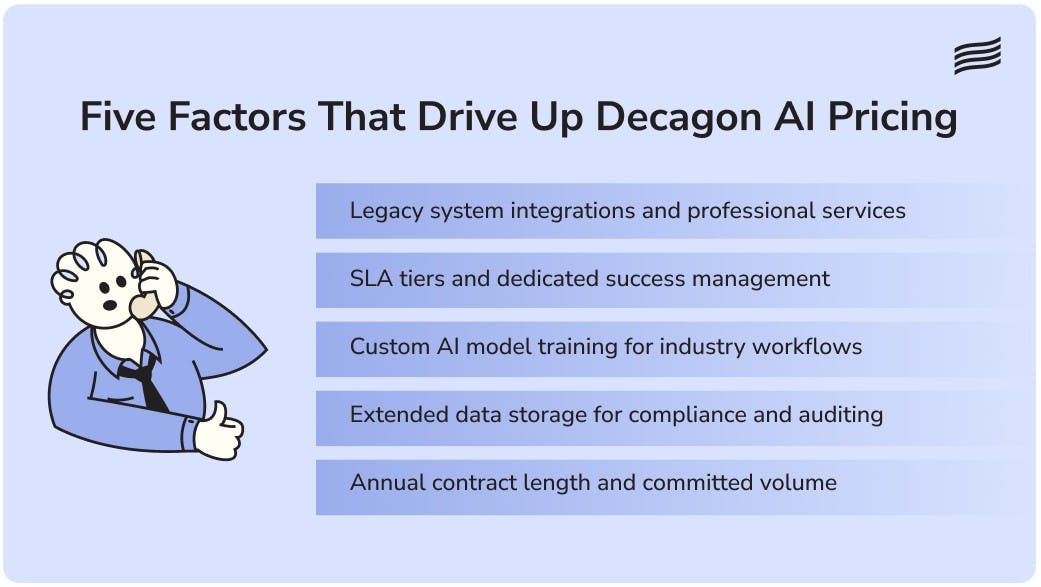
- Support Channel Complexity: Connecting AI to email, chat, and voice simultaneously typically costs more than a single-channel deployment. The added complexity of maintaining context across channels is billed as a premium configuration by most enterprise platforms.
- Integration Requirements: Connecting to custom ERPs or legacy ticketing systems usually triggers professional services fees. These fees significantly increase the total Decagon AI cost, well beyond any initial estimate.
- Service Level Agreements: Enterprises requiring 99.99% uptime guarantees or dedicated customer success managers will face a premium markup applied on top of their base platform fee. This is a common but often-underestimated cost driver in enterprise AI contracts.
- AI Model Customization: Fine-tuning models for highly specific industry jargon or complex escalation workflows typically moves customers into the highest Decagon AI pricing tier available. Standard configurations rarely accommodate niche operational needs without additional cost.
- Data Retention Policies: Extended data storage for compliance, auditing, or legal requirements generally incurs additional storage fees. These fees apply beyond the standard retention period included in the base license and scale with data volume over time.
What Are the Hidden Costs in Decagon AI's Per-Resolution Model?
Many enterprise platforms like Decagon use a per-resolution pricing model that sounds straightforward on the surface. You only pay when the AI successfully closes a ticket, which appears to align incentives between vendor and buyer.
The reality, however, introduces ambiguity and operational friction that operations teams rarely anticipate before signing.
- Defining a Resolution Is Contentious: Disputes frequently arise over what constitutes a successful resolution in practice. If a customer contacts support again within 24 hours on the same issue, was the original ticket truly resolved, or does the business pay twice for the same problem?
- Unpredictable Monthly Spend: As AI adoption scales and volumes grow, resolution counts can rise sharply and without warning. Finance teams then struggle to reconcile approved monthly budgets against invoices that reflect actual system performance rather than projected estimates.
- Incentivizing Premature Ticket Closure: To maximize resolution metrics, some AI models may be configured to close tickets aggressively. This can frustrate customers who genuinely need a human to step in, ultimately damaging satisfaction scores while inflating the vendor's reported success rate.
Why Do Operations Teams Struggle with Opaque AI Pricing?
For agile teams moving quickly, the contact sales barrier is more than an inconvenience; it is an operational bottleneck that slows procurement and delays value delivery.
- Slow Procurement Cycles: Weeks can be consumed in back-and-forth email chains simply to receive a ballpark figure for Decagon AI pricing. This delays AI call automation projects that would otherwise begin generating ROI immediately.
- Difficulty Calculating ROI: Without clear unit costs, modeling the potential return on investment before committing to a contract becomes an exercise in guesswork. Boards and finance leaders expect concrete numbers, not vendor-estimated ranges shared during a sales call.
- Vendor Lock-in Risk: Heavy upfront investments combined with annual contract structures make switching providers financially painful if system performance does not meet the expectations set during the sales process.
- Rigid Scaling Terms: Fixed contracts frequently require renegotiation every time a business needs to add capacity or reduce volume. This slows the ability to react to market changes and undermines the operational agility that AI deployment is supposed to create.

Ringg AI: A Transparent Alternative for Modern Operations
While enterprise giants rely on pricing opacity, we built Ringg AI on a different principle. We believe that the Decagon AI pricing model belongs to the legacy era of enterprise software sales, where vendors hold information as leverage rather than earning trust through transparency.
Ringg AI is designed for modern operations teams who value speed, clarity, and complete control over their budgets without waiting months for a procurement cycle to complete.
We offer a unified, usage-based pricing model that bundles telephony, AI intelligence, and workflow orchestration into a single, predictable per-minute rate. There are no six-figure implementation fees, no ambiguous resolution definitions, and no barriers to starting immediately.
You pay for the minutes you use, which means you can scale up or down based on actual business needs rather than contract commitments made during a sales call.
- All-In-One Rate: Telephony carrier fees, speech-to-text processing, LLM tokens, and voice synthesis are all included in one simple per-minute price. There are no line items that suddenly appear on month three of your deployment.
- No Success Tax: We do not charge more when the system performs well. Our goal is to facilitate the best possible conversation on every call, not to optimize billing metrics at your expense.
- Instant ROI Visibility: With transparent Decagon AI pricing alternatives like ours, you can calculate the exact cost of automating 1,000 calls before you even begin a trial. No sales call required to get to a real number.
How Do Decagon AI Costs Compare Against Ringg AI?
The cost structure comparison reveals that Decagon AI relies on custom annual contracts while Ringg AI cost structure provides predictable per-minute billing. Ringg AI eliminates the massive implementation fees and hidden retainers commonly associated with traditional enterprise automation platforms.
To understand the real value difference between the two platforms, let’s see how Ringg AI cost compares to Decagon AI pricing:
| Cost Component | Decagon AI (Estimated) | Ringg AI |
|---|---|---|
| Pricing Model | Custom / Per-Resolution | Transparent / Per-Minute |
| Entry Barrier | High (Annual Contracts) | Low (Pay-as-you-go) |
| Setup Fees | Significant Implementation Costs | None (Self-Serve Setup) |
| Transparency | Contact Sales | Published and Predictable |
| Telephony | Likely Separate Integration | Native and Bundled |
Is Decagon AI Pricing Worth the Investment in 2026?
In 2026, the speed of implementation is as important as the capabilities of the AI itself. A platform like Decagon AI may offer powerful tools for large enterprises, but when those tools sit behind a three-month procurement cycle and a customized five-figure contract, the opportunity cost accumulates quickly.
Ringg AI allows businesses to bypass the black box of enterprise sales entirely. By removing the friction of opaque Decagon AI cost negotiations, we empower operations leaders to deploy working solutions today rather than next quarter.
Whether you are scaling a support team or automating outbound logistics, the ability to see the price, test the value, and scale usage on your own timeline is the most important competitive advantage any AI platform can offer.
See Ringg AI in action. Book your free demo today.
Frequently Asked Questions
Decagon AI does not publish pricing publicly. Costs are determined through a custom sales process and typically involve annual contracts, per-resolution or per-conversation billing, and additional fees for implementation and integrations. Expect enterprise-level pricing that scales with ticket volume and system complexity.
Related Articles
Is Sierra AI Pricing Worth It In 2026? A Close Look at Cost vs Value
A 2026 pricing reality check: why Sierra’s opaque enterprise model can get expensive, and how Ringg AI lowers risk.
How Much Does Retell AI Cost In 2026? (+ A Better Alternative)
Explore Retell AI pricing in 2026: true per-minute cost, hidden fees, and a simpler alternative—Ringg AI.
Top 7 Retell AI Alternatives for Businesses in 2026
Stop debugging APIs and start automating calls. Discover the top Retell AI alternatives built for enterprise scale, reliability, and predictable pricing.